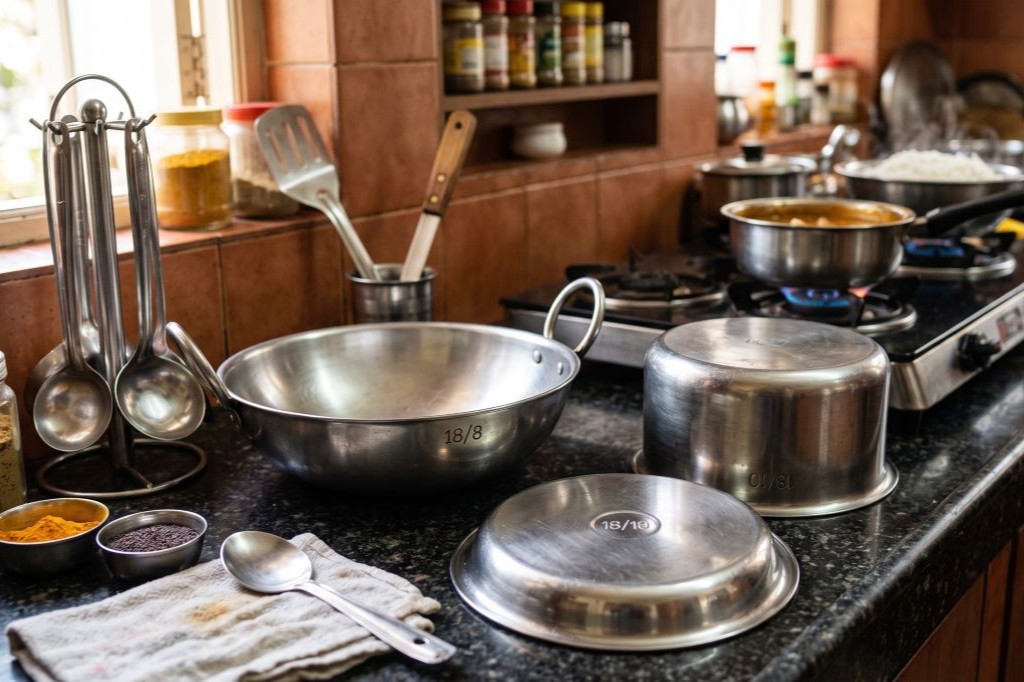
If you have ever turned over a steel bowl, spoon, or dinner plate and noticed numbers like 18/8 or 18/10 stamped on the base, you are not alone in wondering what they mean. These markings appear on stainless steel utensils sold across India and internationally, yet most buyers have no clear understanding of what the numbers indicate or why they matter.
The short answer is that these numbers describe the chemical composition of the steel, specifically, how much chromium and nickel it contains. But the longer answer is more interesting, because understanding these numbers helps you make better decisions when buying kitchenware, tableware, or cutlery for your home, restaurant, or business.
The Basic Chemistry Behind Stainless Steel
Stainless steel is not a single material. It is a family of iron-based alloys that contain chromium as a primary additive, along with other elements in varying proportions. It is the chromium in the alloy that gives steel its defining characteristic, resistance to rust and corrosion. When chromium is exposed to oxygen, it forms a thin, invisible oxide layer on the surface of the metal. This passive layer acts as a self-repairing protective shield, which is why stainless steel does not rust the way ordinary iron does.
Beyond chromium, most food-grade stainless steel also contains nickel. Nickel enhances corrosion resistance further, gives the metal its characteristic silver-like shine, and makes the alloy more ductile, easier to press and form into complex shapes like dabbas, bowls, thalis, and katoris. The balance between these two elements, chromium and nickel is what the 18/8 and 18/10 notation communicates.
What the Numbers 18/8 and 18/10 Actually Represent
The notation is straightforward once you know the key: the first number is the percentage of chromium in the alloy, and the second number is the percentage of nickel. Everything else is primarily iron, with small traces of carbon, manganese, and silicon.
18/8 stainless steel contains 18% chromium and 8% nickel. It is one of the most widely used grades in kitchenware production globally, and corresponds closely to what is technically classified as Grade 304 stainless steel. The high chromium content provides strong rust resistance, while the 8% nickel adds shine and improves the steel’s ability to withstand acidic foods and repeated washing.
18/10 stainless steel contains 18% chromium and 10% nickel, the same chromium level, but with 2% more nickel. This additional nickel gives 18/10 steel a marginally higher resistance to corrosion and a slightly brighter, more lustrous finish. For this reason, 18/10 is often positioned as a premium grade and is frequently used in high-end flatware, serving stainless steel spoons, and cutlery for hotels and fine dining establishments.
In practice, the difference between 18/8 and 18/10 is subtle for most everyday kitchen uses. Both grades meet international food-safety standards, both resist rust under normal conditions, and both are suitable for storing and serving a wide variety of Indian foods, including those with tamarind, lemon, or other acidic ingredients. The distinction becomes more visible over time in terms of lustre and in environments with higher moisture or salt exposure.
How These Grades Compare to Common Steel Grades in India
The 18/8 and 18/10 notations are essentially marketing-friendly shorthand for technical grades used in the manufacturing industry. Understanding how they map to the broader grading system helps put them in context.
Grade 304 – The Most Common Food-Grade Steel
Grade 304 is the technical name for the family of steel that encompasses both 18/8 and 18/10. According to international standards, Grade 304 specifies a chromium content of 18 to 20% and a nickel content of 8 to 10.5%. Whether a manufacturer labels their product as 18/8 or 18/10, the underlying steel is almost always Grade 304. For everyday kitchenware, plates, bowls, spoons, storage containers, Grade 304 is widely regarded as the standard choice for quality and food safety.
If you want to understand the full comparison across stainless steel grades used in India, including how Grade 202 differs from Grade 304, the existing guide on stainless steel grades covers this in depth and is worth reading alongside this article.
Grade 202 – The Budget Alternative
Grade 202 is a common lower-cost alternative found in value-segment utensils sold in India. It uses less nickel and compensates with higher manganese and nitrogen content. While it is suitable for many basic kitchen applications, it is more susceptible to corrosion than Grade 304, particularly in humid coastal climates or when used to store acidic or salty foods over extended periods. Utensils made from Grade 202 will generally not carry an 18/8 or 18/10 stamp.
Grade 316 – Marine Grade
Grade 316 adds molybdenum to the 304 composition, giving it significantly stronger resistance to chlorides — salt, sea air, and harsh cleaning agents. It is sometimes labelled as 18/10 as well, which can cause confusion. In reality, 316 is a step above consumer-grade 18/10 and is used more commonly in industrial food processing, medical equipment, and coastal applications than in household kitchenware.
Why is 18/10 Considered “Premium” Over 18/8?
The premium positioning of 18/10 over 18/8 has both a technical and a marketing dimension. On the technical side, the extra 2% nickel does contribute marginally to better shine retention and slightly improved resistance to tarnishing and pitting over years of use. The finish on 18/10 steel tends to hold its mirror polish longer, especially in comparison against restaurant-grade dishwashing cycles.
On the marketing side, 18/10 labelling has become a signal of quality in the global cutlery and flatware industry. Premium dinner sets, hotel silverware, and high-end serving spoons are frequently marketed as 18/10 to communicate a level above the standard. For Indian consumers buying a stainless steel dinner set or a tableware set for long-term use, 18/10 is a reliable indicator of above-average material quality.
That said, for most practical purposes in Indian homes, cooking, serving, storage, and everyday eating, the performance difference between 18/8 and 18/10 utensils of comparable thickness is not significantly noticeable in daily use. The gauge (thickness) of the steel often has a greater impact on perceived quality and durability than the small difference in nickel content.
What about 18/0 Stainless Steel?
Some utensils, particularly budget flatware and knives, carry a stamp of 18/0. This means 18% chromium and no nickel. It belongs to the 400-series stainless steel family, which is ferritic rather than austenitic. Without nickel, 18/0 steel is less corrosion-resistant and less shiny than 18/8 or 18/10, but it has one notable advantage: it is magnetic. This makes it compatible with induction cooktops, which is why some cookware uses an 18/0 or 430-grade steel plate on the base for induction compatibility, even if the body is made from 304 steel.
18/0 steel is adequate for dry-use cutlery like knives, but it is not ideal for items that will be exposed to moisture, salt, or acidic foods for extended periods. Most quality stainless steel kitchenware sold in India uses either 202, 304 (18/8), or higher grades for the main body.
How to Identify the Grade Stamped on Your Utensils
Checking the grade stamped on a utensil is straightforward. Most reputable manufacturers mark the grade on the base or underside of the product. Look for stamps like 18/8, 18/10, SS 304, or FOOD GRADE. If no grade marking is visible at all, it is a reason for caution, genuine quality stainless steel manufacturers almost always disclose the steel grade on their products.
A simple at-home test is the magnet test. True Grade 304 (18/8 or 18/10) austenitic steel is either weakly magnetic or non-magnetic. A strong magnetic pull suggests the steel may be a lower grade, such as 202 or 430. This is not a definitive test, but it is a useful quick check when a grade stamp is absent.
Another approach is to look at the product’s finish and weight. Thicker-gauge 18/10 steel will feel noticeably more substantial than thin-gauge 18/0 or low-grade 202 steel of the same product size. Reputable stainless steel kitchenware manufacturers who work with food-grade steel will also be able to share material test reports (MTRs) or BIS certification on request.
Does the Grade Marking Matter More for Some Products Than Others?
Yes. The grade of steel matters more in some applications than others, and knowing this helps you prioritise where to invest in quality.
Spoons and cutlery: Items that go directly into your mouth and stay in contact with food for extended periods benefit most from 18/8 or 18/10 steel. Stainless steel spoons made from food-grade material are non-reactive and safe even with acidic or hot foods.
Thalis and dinner plates: For traditional stainless steel thali and tray sets, the grade matters because these items are used daily with a range of Indian foods, including those cooked with tamarind, tomatoes, and lemon. Grade 304-equivalent steel performs reliably in these conditions over the long term.
Storage containers and dabbas: Containers used to store pickles, chutneys, or other acidic preserves over longer periods benefit from 18/8 or higher steel. Lower-grade steel in this application may show pitting or discolouration over time.
Serving trays and decorative items: For trays used primarily for dry or non-acidic foods, and items handled rather than used for cooking, Grade 202 can be adequate and cost-effective.
Why Indian Kitchens Should Pay Attention to These Markings
Indian cooking is, by global standards, especially demanding on cookware and utensils. Tamarind-based gravies, tomato curries, lemon rice, and pickles all have higher acidity than typical European or East Asian cuisines. Coastal Indian kitchens add humidity and salt air to this picture. In this context, the grade of steel matters more than it might in lower-stress culinary environments.
The growing awareness of food safety, including concerns about material leaching from plastics and substandard metals, has pushed Indian buyers to look more carefully at what their utensils are made from. An 18/8 or 18/10 stamp is not just a marketing claim; it is a verifiable indicator of the alloy composition, and understanding it helps you make smarter choices for your family’s health and for the longevity of your kitchen investments.
A Quick Summary
18/8 = 18% chromium, 8% nickel. Corresponds to Grade 304. Widely used, food-safe, corrosion-resistant, good for everyday kitchenware.
18/10 = 18% chromium, 10% nickel. Also essentially Grade 304. Slightly higher nickel content for better lustre and marginal corrosion resistance. Common in premium flatware and tableware.
18/0 = 18% chromium, no nickel. Grade 400 series. Magnetic. Less corrosion-resistant. Suitable for dry-use items or induction-compatible cookware bases. For most Indian households, choosing utensils stamped with 18/8 or 18/10, or confirmed Grade 304, is a sound standard for everyday cooking, dining, and food storage. The difference between the two is subtle in daily use, but either is a meaningful step above ungraded or low-grade steel.