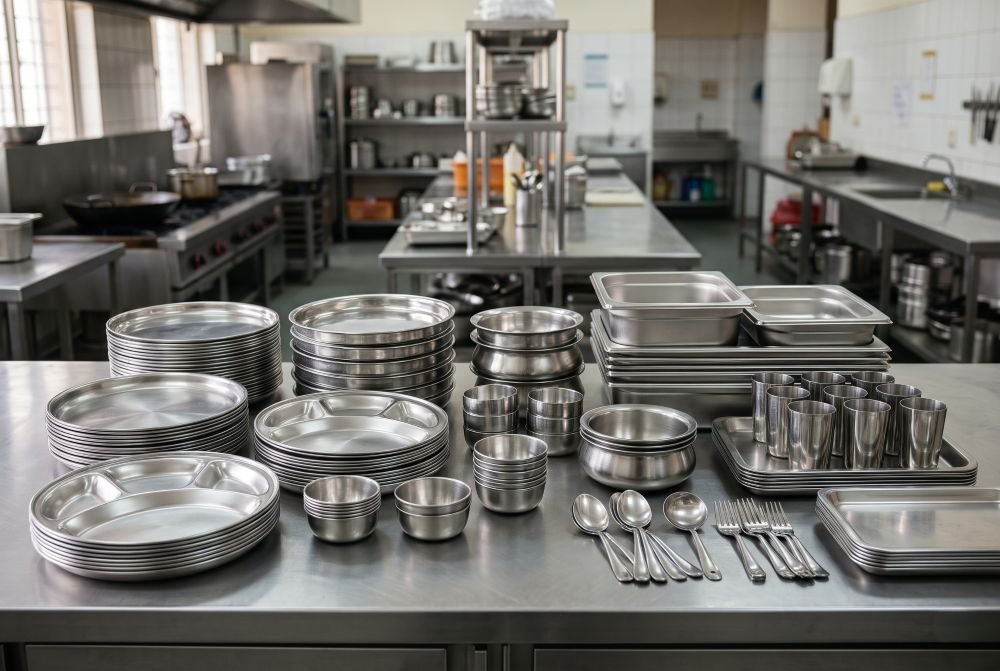
A new restaurant, a corporate cafeteria, a hospital canteen or a hostel mess all face the same moment: a long list of thalis, katoris, glasses, serving bowls and buckets that need to be bought at once, in quantities measured in hundreds rather than dozens. The order is large enough that a wrong decision costs real money, and the utensils will be washed, stacked and banged around several times a day for years.
Price per piece is usually the first number procurement teams look at, and it is the least useful one on its own. A thali that dents after three months, a glass that stains in a dishwasher, or a serving bowl that does not stack will cost far more in replacements, breakage and slower service than the saving on the purchase order.
This guide walks through what actually matters when buying stainless steel utensils in bulk for commercial food service in India: material grade, sheet thickness, certification, construction, design for high-volume service, how to calculate quantities, and what to agree with a supplier before the order is placed.
Choosing the Right Stainless Steel Grade
Not all stainless steel behaves the same way in a commercial kitchen. The grade determines how well the utensil resists corrosion from salt, acidic gravies, detergents and constant moisture, and it is the single biggest factor in how the utensils look after a year of service.
Most utensils sold in India are made from either a 200-series grade such as 202, or a 300-series grade such as 304. Some items, particularly magnetic bases and cheaper cutlery, use 430, a ferritic grade with very little nickel.
Grade 202 for General Service
Grade 202 replaces part of the nickel in stainless steel with manganese, which brings the cost down significantly. It is widely used for everyday thalis, katoris, plates and storage containers across Indian households, dhabas and canteens, and in normal use it performs well.
Its limitation is corrosion resistance. In very humid coastal locations, or where utensils sit wet with salty or sour food residue for long periods, 202 is more likely to show surface spots and pitting over time. For most canteens with prompt washing, it remains a practical and economical choice.
Grade 304 for Demanding Environments
Grade 304 contains around 18 percent chromium and 8 percent nickel, often marked as 18/8, and offers noticeably higher resistance to corrosion. It is the grade typically specified for hotels, hospital kitchens, export orders and any setting where utensils face industrial dishwashers, strong detergents or acidic foods like tamarind-based sambar, rasam and pickles.
The price difference between 202 and 304 is real, so many operators use a mixed approach: 304 for stainless steel kitchenware such as cooking vessels and items in constant contact with hot, acidic food, and 202 for plates, glasses and serving ware that are washed promptly. Our explainer on what 18/8 and 18/10 mean on steel utensils covers the stamps you will see on 300-series products.
Thickness and Gauge
Thickness is the second factor that decides how long commercial utensils last. A thin thali flexes when lifted with food on it, dents when dropped in a wash area and loses its shape after repeated stacking. A thicker one costs more per piece but survives far longer.
Suppliers may quote thickness in millimetres or in gauge, where a higher gauge number means thinner sheet. For commercial use, ask for the finished thickness in millimetres in writing, because the same “heavy” label can mean very different things from one supplier to the next.
Checking Thickness Without Tools
Weight is the simplest proxy for thickness when comparing samples of the same size and design. Weigh two thalis of identical diameter on a kitchen scale; the heavier one is almost always made from thicker sheet, assuming the grade is the same.
Press the centre of a plate with your thumb and see whether it flexes, and tap the rim against a hard surface to listen for a solid sound rather than a tinny one. These checks are crude but very effective when comparing samples side by side.
Where Thickness Matters Most
Thalis, serving trays and buckets take the most physical abuse in a canteen. They are carried full, stacked high and often dropped in wash areas, so these are the items where it pays to choose a heavier gauge.
Katoris, glasses and spoons can be lighter, because they are smaller and less likely to bend. Matching thickness to the role of each item keeps the total budget under control without compromising on the pieces that wear out fastest.
BIS Certification and Food Safety
Stainless steel utensils sold in India are required to conform to IS 14756 and carry the BIS Standard Mark under the Quality Control Orders covering cookware and utensils. The standard sets minimum requirements for material, thickness, workmanship and marking for cooking, serving, table and storage utensils.
For a bulk buyer, the BIS mark is a quick first filter. A supplier who cannot show a valid BIS licence for the products being quoted is either selling old stock or operating outside the rules, and neither is a good basis for a large order. Our article on BIS certification for stainless steel utensils explains what the licence covers.
Food Contact and Hygiene
FSSAI hygiene requirements for food businesses expect food contact surfaces to be made of non-toxic, corrosion-resistant materials that can be cleaned easily. Stainless steel meets this naturally, but design matters too: sharp internal corners, rolled rims that trap water and poorly finished welds all harbour food residue.
During sample inspection, run a finger along every rim and joint. Smooth, fully closed edges are easier to clean and safer for staff and diners alike. Visible gaps or rough patches are a sign of rushed finishing.
Construction and Design for High-Volume Service
The way a utensil is made affects both durability and hygiene. Many thalis, bowls and containers are produced by deep drawing, a process that presses a single sheet into shape without seams. Seamless construction removes joints where food can lodge and where cracks tend to start, which is why deep-drawn pieces are preferred for high-volume service.
Beyond construction, commercial utensils need to suit the way a busy kitchen moves. Design details that seem minor in a showroom make a large difference when hundreds of plates are being served and washed every hour.
Stackability
Utensils that nest cleanly save shelf space, reduce breakage and speed up the wash-to-service cycle. Check that thalis stack flat without sliding, that katoris nest inside each other and that glasses do not get stuck together when stacked wet.
Bring several samples of each item and stack them before ordering. A design that wobbles or locks together will slow the wash area every single shift.
Finish
Mirror-finished utensils look attractive on day one but show scratches quickly under heavy use, especially when stacked or cleaned with abrasive scrubbers. Matte or satin finishes hide wear far better and are often preferred for canteens and institutional kitchens.
The finish also affects how utensils look after commercial dishwashing. Our comparison of mirror finish and matte finish in stainless steel utensils covers how each holds up over time.
Sizes That Match the Menu
A South Indian meals counter, a North Indian thali restaurant and an office canteen serving combo meals all need different plate sizes and compartment layouts. Compartment thalis reduce the need for separate katoris but limit flexibility if the menu changes.
Map the menu first, then choose sizes. Standard stainless steel thali sets come in a range of diameters and compartment layouts, and choosing the right size avoids both wasted food and overcrowded plates.
Calculating Bulk Quantities
Under-ordering forces staff to wash plates mid-service, which slows the queue. Over-ordering ties up cash and storage space. The right quantity depends on peak covers, the speed of the wash cycle and the expected loss rate.
A common starting point is to keep two to three times the number of seats or peak covers per sitting for plates and glasses. Faster dishwashing allows a lower multiple, while manual washing and long service windows need a higher one.
Accounting for Loss and Damage
Utensils go missing in canteens, especially spoons and glasses, and some get damaged beyond use every month. Build a buffer of 10 to 15 percent for cutlery and small items, and 5 to 10 percent for plates and larger pieces, depending on the setting.
Record losses for the first three months of operation. Actual figures are far more reliable than estimates, and they make the next reorder much more accurate.
Planning for Reorders
Buying the same design again in a year is harder than it sounds. Suppliers change designs and finishes, and mismatched plates on a service counter look careless. Ask whether the chosen design is a standard catalogue item that will remain available.
For large institutions, it can be worth ordering a reserve stock upfront rather than relying on future availability. Storing an extra 10 percent is often cheaper than replacing an entire set later because one item no longer matches.
Evaluating a Supplier
For orders running into lakhs of rupees, the supplier matters as much as the product. Buying directly from a stainless steel utensils manufacturer rather than through several layers of traders usually gives better control over grade, thickness and consistency across batches.
Ask every shortlisted supplier for the same information so quotes can be compared fairly: grade, finished thickness in millimetres, weight per piece, BIS licence details, minimum order quantity, lead time and replacement terms for defective pieces.
Samples and Batch Consistency
Always approve physical samples before placing the order, and keep one approved sample of each item. When the bulk delivery arrives, compare random pieces against the sample for weight, finish and dimensions.
Consistency is a common problem with large orders. A supplier who sources sheet from different mills may deliver pieces that look slightly different in colour or finish. Writing the approved sample into the purchase order gives you a clear basis for rejection.
Payment, Delivery and After-Sales Terms
Agree on delivery schedules, packing standards and what happens if pieces arrive dented or the wrong grade. Staggered deliveries help when storage is limited, and a defined replacement window protects against defects that only appear after a few weeks of use.
It is also worth asking whether the supplier can handle future top-up orders in smaller quantities. Canteens rarely need another full set, but they almost always need extra spoons, glasses and katoris within the first year.
Conclusion
Buying stainless steel utensils in bulk for a restaurant or canteen is a long-term decision disguised as a purchase order. The right grade, adequate thickness, BIS-compliant products and practical designs that stack and clean easily will save far more over the life of the utensils than a lower unit price.
Choose 304 where utensils face acidic food, strong detergents or coastal humidity, and use 202 where washing is prompt and budgets are tight. Insist on thickness in millimetres, approve physical samples, and order enough to cover peak service, losses and future reorders. Finally, treat the supplier as a long-term partner. Consistent batches, clear replacement terms and the ability to supply top-up orders will matter every month the kitchen is running.