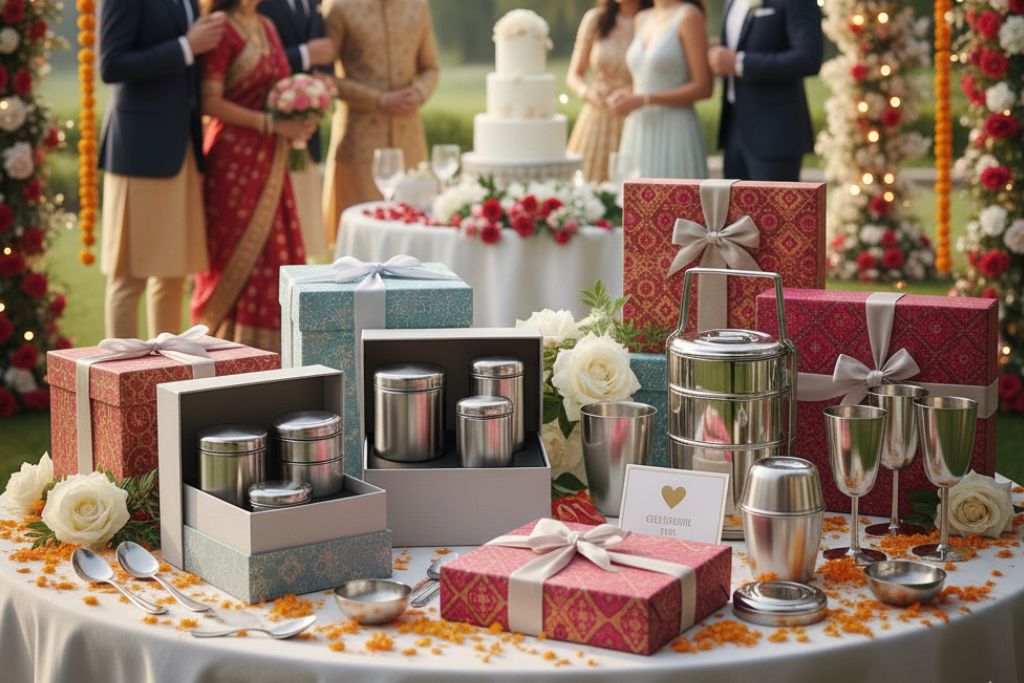
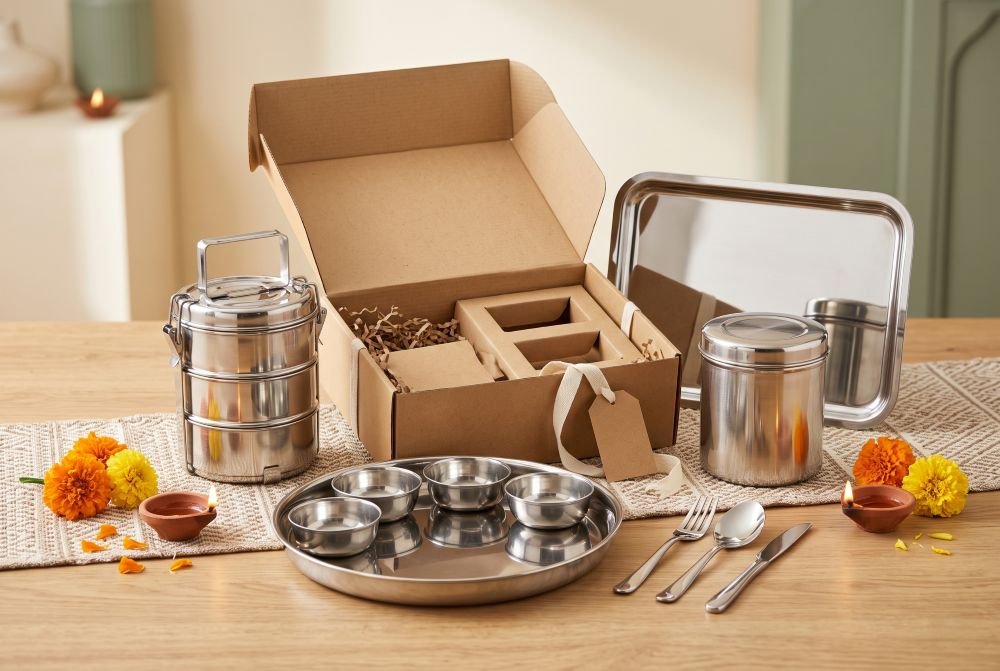
Every Diwali, the weeks before the festival produce a familiar pile of waste: cellophane-wrapped hampers, plastic trays, shiny boxes that are opened once and discarded, and decorative items that never find a place in the recipient’s home. For businesses that have set sustainability targets, this seasonal habit sits awkwardly beside their stated commitments.
Companies under growing pressure from investors, customers and regulators, including the business responsibility reporting expected of large listed Indian firms, are looking again at what they give. The most credible answer is a gift that people keep and use for years, and options such as reusable stainless steel corporate gifts fit that description better than most festive items.
This article explains what makes a corporate gift genuinely sustainable, how to avoid the traps of vague environmental claims, which reusable categories suit Diwali gifting, and how to plan packaging and reporting so that the gesture holds up to scrutiny.
Stainless Steel Gift Ideas for Sustainable Diwali Corporate Gifting
Stainless steel offers a wide range of reusable gifts, and most of them are items that Indian households already use daily. That familiarity is an advantage, because the recipient knows exactly what to do with the gift.
The categories below are those most often chosen by businesses that want gifts to be both useful and long-lived.
Stainless Steel Dabbas and Canisters
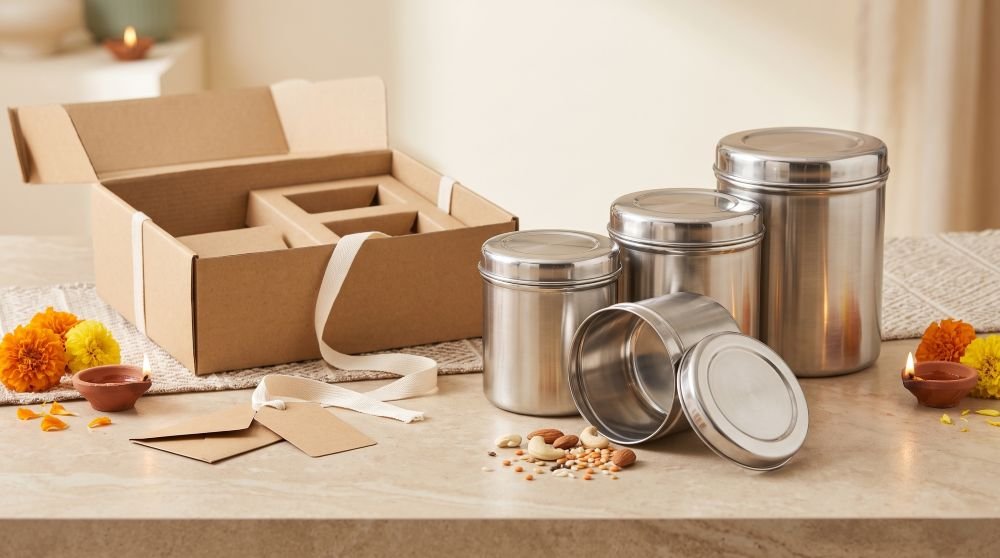
Stainless steel dabbas and canisters replace plastic storage containers in the kitchen, and a set in graduated sizes can hold grains, spices, tea or dry fruits for decades.
A steel dabba set can replace several plastic containers over its life, so each recipient who switches carries the benefit for years. Plain designs without paint or printed coatings also keep the item simple to recycle at the end of its service.
Stainless Steel Tiffin Boxes
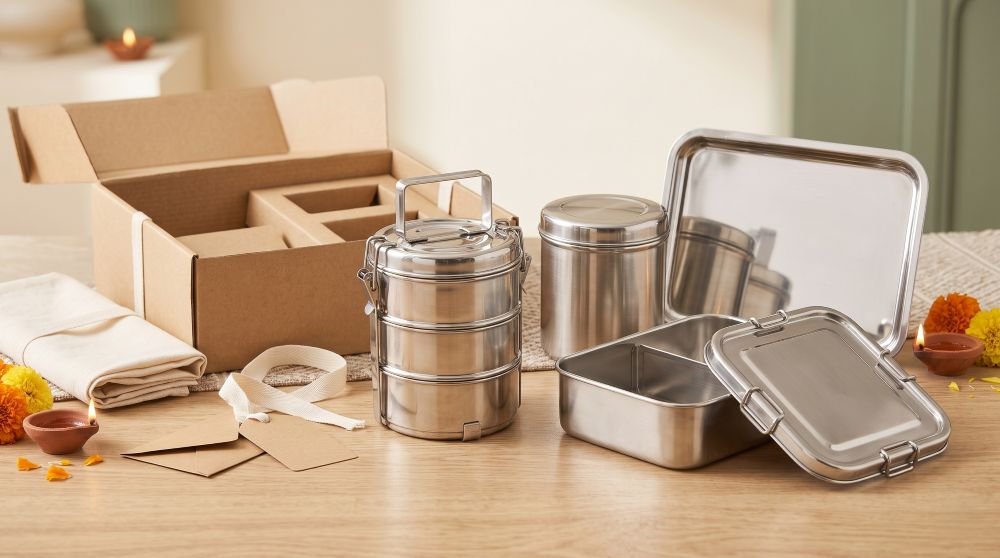
Stainless Steel Tiffins give employees a reusable alternative to disposable lunch packaging, which makes them a direct and visible way to cut single-use waste.
Employees who bring lunch from home use a tiffin nearly every working day, which makes this one of the most visible reuse gifts. A company can reinforce the gesture by pairing it with a simple internal message about cutting disposable lunch packaging.
Thali Sets and Trays
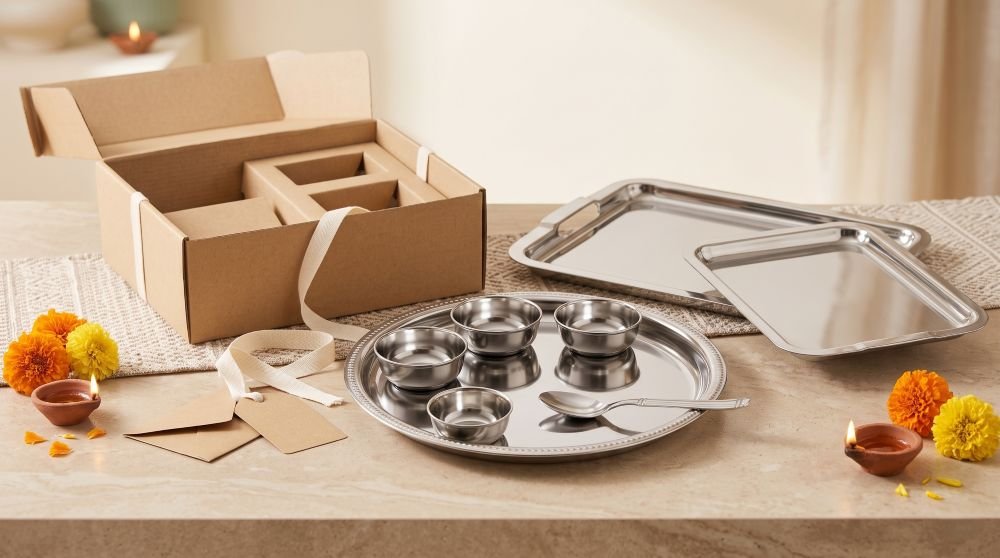
A stainless steel thali and tray set is a traditional reusable dining set that suits festive meals and everyday use, and it replaces disposable plates at gatherings.
Reusable thali sets are well suited to festive gatherings, where disposable plates and cups are otherwise common. A household that keeps a set for guests can avoid hundreds of single-use items over the years.
Spoons and Cutlery
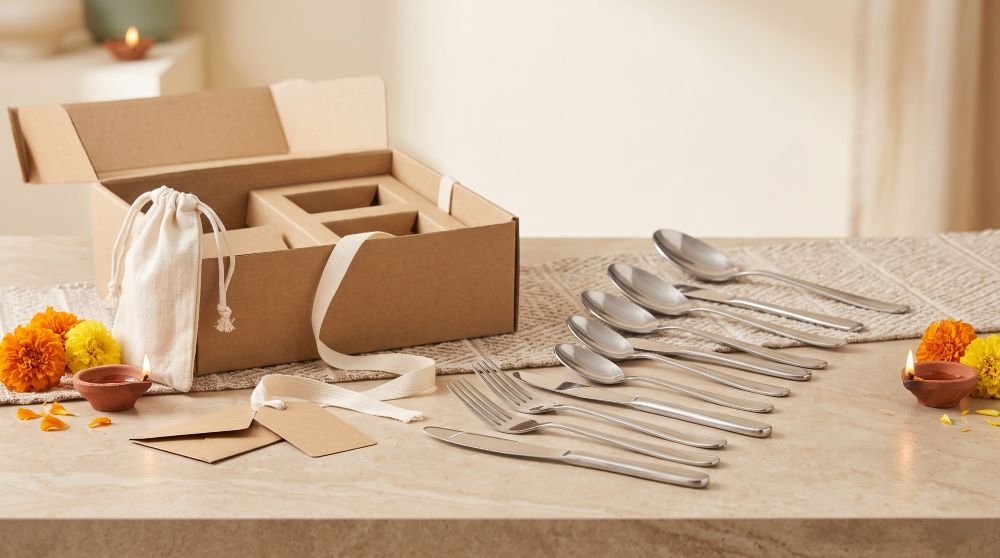
Stainless steel spoons and cutlery work as reusable alternatives to plastic cutlery, and a compact set is easy to carry to work or on journeys.
Carrying a personal spoon set to work or while travelling removes the need for plastic cutlery at the canteen or on the road. The set is small and light, which makes it easy for recipients to adopt the habit.
Tableware Sets
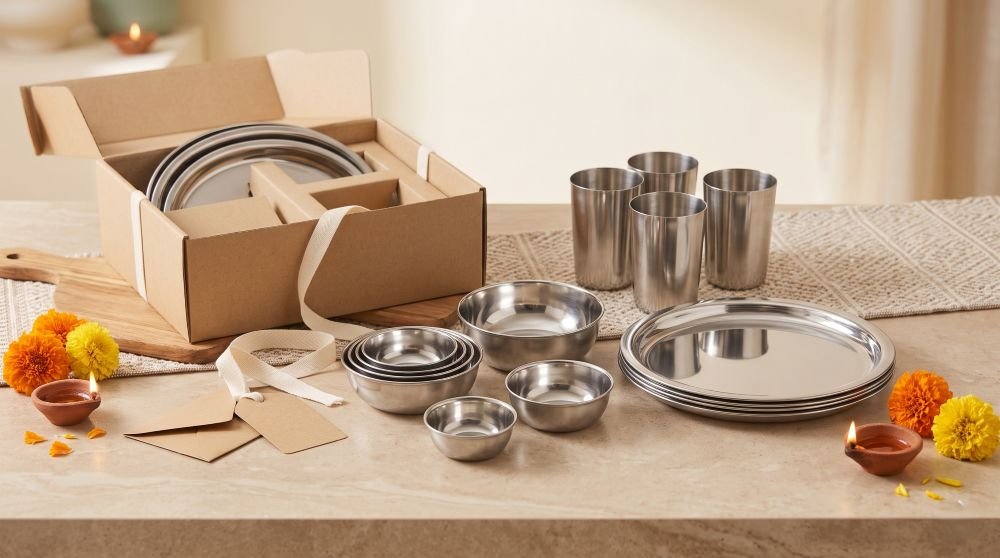
Bowls, plates and serving pieces from a stainless steel tableware range suit longer-term gifts for clients and partners who host guests regularly.
Clients and partners who host regularly will use tableware often, so the item’s lifespan is long. Choosing a timeless, unbranded design keeps the set in use even if tastes change.
Kitchen Essentials
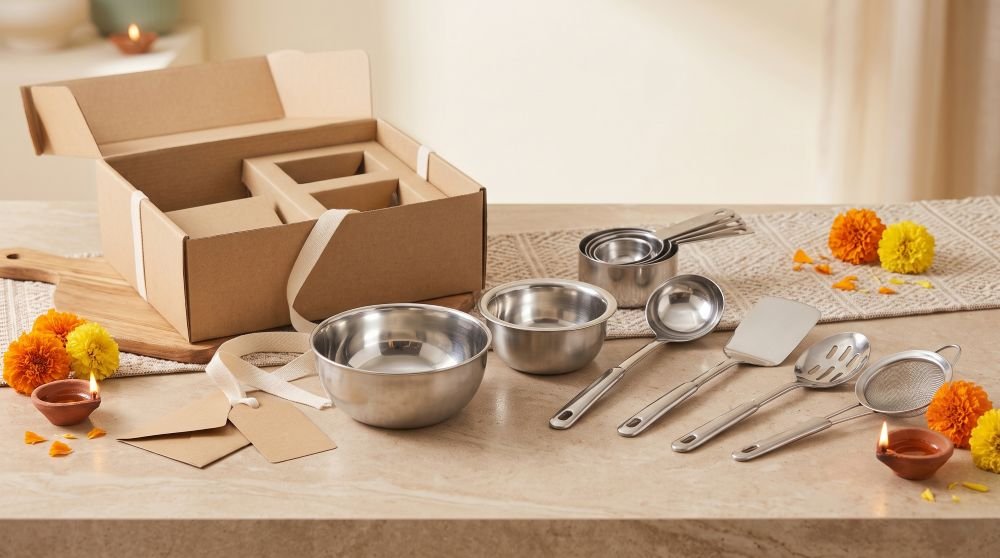
Practical items from stainless steel kitchenware give households everyday tools that are built to last for many years.
Simple designs with no coatings or detachable decorative parts are easy to maintain, and they remain recyclable when the item finally reaches the end of its life. Items that last for decades also reduce the waste that comes with replacements.
What Makes a Corporate Gift Sustainable
Sustainability in gifting is easy to claim and harder to demonstrate. A gift is not sustainable simply because it uses a natural material or carries a green leaf on its label. The better test is whether the item will still be in use years from now, and whether the resources used to make, pack and deliver it are justified by that long life.
Three factors do most of the work: how long the gift lasts, what happens to the material at the end of its life, and how far it has travelled to reach the recipient. Each is examined below.
Durability and Daily Use
A gift that is used every day for a decade has a far smaller footprint per use than one used for a week. Stainless steel is hard-wearing, does not shatter, and tolerates daily washing and heat, which is why steel dabbas, thalis and spoons are often handed down within Indian families. The longer an item survives, the more convincing its sustainability case becomes.
Durability only counts if the recipient actually uses the item, so usefulness matters as much as strength. A canister that sits in a kitchen cupboard and holds atta or dry fruits every month is a better sustainable gift than an elaborate steel sculpture that ends up in storage.
Recyclability at End of Life
Stainless steel can be recycled repeatedly without losing its essential properties, and discarded steel utensils have long had a place in India’s scrap and re-melting chain. That is a meaningful advantage over mixed-material gifts, such as items that combine plastic, adhesives and coatings, which are difficult to separate and recycle.
Simple, single-material items are generally easier to recycle than composite ones. When comparing gift options, it is worth asking what the item is made from, whether it can be separated into its parts, and whether the packaging is also recyclable or compostable.
Local Manufacturing and Shorter Supply Chains
Where a gift is made affects its footprint. Items produced in India for Indian recipients avoid long international shipping and support domestic manufacturing hubs such as Mumbai, Rajkot, Ahmedabad and Yamunanagar, which have long histories in utensil production. Shorter supply chains also make it easier to verify materials and working conditions.
Bulk orders can be consolidated and dispatched in a small number of shipments, which cuts the emissions of delivery compared with many small parcels. Planning early and shipping together is one of the simplest ways to reduce the impact of a large gifting programme.
The Problem With Disposable Festive Gifting
Festive gifting has traditionally leaned on items with short lives: boxed sweets, decorative lights, plastic-wrapped hampers and novelty items bought in quantity. Much of this is discarded within days, and the packaging often outweighs the content. In India, rules on single-use plastics, which restrict a list of identified items from July 2022, have pushed many businesses to rethink hamper trays and wrapping, though plenty of plastic still finds its way into festive packages.
Cost is also a factor. A gift that is thrown away has no lasting value to the recipient and no lasting visibility for the sender. A reusable item, by contrast, keeps the sender’s name in daily view and turns the gifting budget into something that works for much longer.
Greenwashing Traps to Avoid
Corporate buyers should be careful about claims made by gift suppliers. Words such as eco-friendly, green or natural have no fixed meaning, and a product described that way may be coated, glued or packaged in ways that undermine the claim. India’s Central Consumer Protection Authority issued guidelines in 2024 aimed at misleading environmental claims, which means that vague marketing language carries growing regulatory risk.
A sound approach is to ask for specifics: the material, where the item was made, how long it is expected to last, and what the packaging contains. A supplier who can answer plainly is more reliable than one who relies on slogans. It also helps to describe your own gift modestly, saying that it is reusable and long-lasting, instead of claiming that it is planet-saving.
Low-Waste Extras That Pair Well With Reusable Gifts
A durable main gift can be supported by small, low-waste extras that suit the festival. Clay diyas, handmade paper cards, cotton pouches and seed-embedded notes all fit the Diwali mood without adding permanent clutter. These should be chosen as modest accompaniments, so the lasting item remains the centrepiece.
Care is needed with food extras. Dry fruits or sweets can be packed inside a stainless steel dabba so that the container itself becomes the gift, removing the need for separate boxes and trays. Where food is included, it should be fresh and clearly labelled.
Low-Waste Packaging for Reusable Gifts

Packaging is where many sustainable gifting efforts fall short. A beautiful steel gift in a plastic-laminated box with foam inserts undermines its own message. Kraft paper, plain cardboard, jute and cotton pouches are simpler alternatives, and they can often be recycled or reused by the recipient.
The most efficient approach is to let the product act as its own packaging. A dabba filled with dry fruits, or a tiffin holding a small card and a few sweets, needs only a light outer wrap. Fewer materials means less waste, and the recipient keeps the container.
Transport packaging also deserves attention. Shared cartons for bulk delivery to a single office, reusable crates for returns and fewer, larger shipments all cut the volume of packaging that ends up as waste. Where recipients are located in the same city, a single drop to a central point can replace dozens of individual parcels.
Questions to Ask a Gift Supplier
A sustainability claim is only as strong as the answers behind it. Before placing an order, procurement teams can ask a short set of questions that quickly separate genuine reuse-focused gifts from products that merely look the part. A supplier who has thought about these points will usually answer without difficulty.
The answers also give the buying team a written basis for any claims they make later, which is useful if the gifting programme is ever reviewed by auditors or by the sustainability team.
- What is the item made from? The supplier should name the material and, for stainless steel, the grade, so that the buyer knows what the item is and how it can be recycled at the end of its life.
- Where was it made? Knowing the place of manufacture helps the buyer judge the transport footprint and confirm that the purchase supports domestic production.
- What does the packaging contain? A clear list of packaging materials shows whether the outer box, inserts and wrapping can be recycled, reused or composted, and whether any plastic is involved.
- How long is the item expected to last? A realistic answer, based on the thickness of the material and the intended use, indicates whether the item is built for years of service or for a single season.
Measuring and Reporting the Impact
A sustainable gifting programme becomes more credible when it is measured. Simple indicators work well: the number of single-use items replaced, the weight of packaging per gift, the proportion of gifts made in India, and any feedback on how recipients are using the items. These figures can be recorded year to year and compared.
Reporting should be plain and accurate. Large listed companies already report on environmental and social metrics, and a short, honest note on how festive gifting fits within that picture is more convincing than a bold claim. Overstating the impact of a gift can do more damage than saying nothing.
Feedback from recipients is the most direct way to learn whether gifts are reused. A short follow-up message or a simple survey a few months after Diwali can show how many recipients are still using the item, and the results can guide the choices made for the following year.
Conclusion
Sustainable corporate Diwali gifting is less about finding an exotic material and more about choosing gifts that people will use for years. Durable, single-material items that suit everyday Indian life reduce waste at the source, and they continue to deliver value long after the festival ends.
Honest communication supports the choice. Asking suppliers for specifics, avoiding vague green claims, trimming packaging and measuring results all help to make a sustainability story hold up under questions from employees, clients and auditors.
A reusable steel dabba, a thali set or a spoon set cannot solve a company’s environmental challenges on its own. It can, however, demonstrate in a small and visible way that the company’s festive habits are consistent with its stated values, and that is a worthwhile place to begin.