The next time you pick up a stainless steel katori, a thali, or a steel dabba, consider what it took to make it. That smooth, seamless, curved form was not cast in a mould, welded together from parts, or carved from a block of metal. It was shaped from a flat sheet of steel using a process called deep drawing, a technique that transforms two-dimensional metal into three-dimensional hollow forms through precisely controlled mechanical pressure.
Deep drawing is one of the most important and widely used manufacturing processes in the stainless steel utensil industry, both in India and globally. Understanding how it works gives you a clearer picture of what separates well-made steel utensils from poorly made ones, why certain products cost more than others, and what quality indicators to look for when evaluating stainless steel kitchenware.
What is Deep Drawing?
Deep drawing is a metal forming process in which a flat circular or rectangular piece of sheet metal, called a blank, is pressed into a cavity or die using a punch to produce a hollow, three-dimensional shape. The term “deep” refers to the fact that the depth of the drawn shape is greater than or comparable to its diameter. A steel katori, for example, might be 60 mm deep and 120 mm in diameter, a depth-to-diameter ratio that qualifies it as a deep-drawn component.
Unlike processes such as casting (where molten metal is poured into a mould) or machining (where material is removed from a solid block), deep drawing involves no addition or removal of material. The metal is plastically deformed, permanently reshaped, without breaking. This is possible because of the inherent ductility of stainless steel: its ability to be stretched and compressed beyond its elastic limit while maintaining structural integrity.
The result is a seamless, single-piece hollow form, no welds, no joints, no seams. This is a critical advantage for food-contact products, because seam-free surfaces are easier to clean, do not harbour bacteria in joints, and do not suffer from weld-zone corrosion over time.
Why Deep Drawing Works with Stainless Steel
Not all metals are equally suitable for deep drawing. The process requires a material that is both ductile (able to stretch without cracking) and strong enough to hold its shape once formed. Stainless steel, particularly the austenitic grades most commonly used in kitchenware, Grade 202, Grade 304, and Grade 316, are well-suited to deep drawing for several reasons.
High ductility: Austenitic stainless steels have a face-centred cubic crystalline structure that allows significant plastic deformation in multiple directions before failure. This means a flat blank can be stretched into a deep bowl or canister shape without tearing.
Work hardening: As stainless steel is deformed during deep drawing, it actually becomes stronger through a process called work hardening. The finished product is meaningfully harder and more rigid than the starting sheet, which contributes to the weight and rigidity you feel in a quality steel bowl or container.
Corrosion resistance is maintained: Provided the drawing process is carried out correctly and the surface is treated and polished afterwards, the corrosion resistance of the steel is preserved across the finished product, important for items that will be in regular contact with food, water, and cleaning agents.
Of the commonly used grades, Grade 304 (equivalent to 18/8 stainless steel) is considered the most ideal for deep drawing because of its higher nickel content, which contributes to ductility. Manufacturers selecting steel grades for utensil manufacturing need to account for both the final product’s food-safety requirements and the material’s formability at each stage of the draw. For a detailed comparison of stainless steel grades used in Indian kitchenware, including the differences between Grade 202 and Grade 304, that comparison is worth reading in the context of material selection.
The Deep Drawing Process: Step by Step
While the specific machinery, tooling, and production parameters vary by manufacturer and product type, the broad steps of the deep drawing process follow a consistent sequence.
Step 1: Raw Material Selection and Preparation
The process begins with selecting the appropriate grade and gauge (thickness) of stainless steel sheet. Sheet coils, long rolls of flat steel, are sourced from steel mills based on specifications for chemical composition, thickness tolerance, surface quality, and mechanical properties. The selection of material at this stage is critical: a sheet that is too thin will not produce adequate wall thickness in the finished product, while one that is too thick will require greater force to draw and may cause cracking at the edges of the blank.
The sheet may undergo initial quality checks, including verification of the steel grade through mill test certificates, before it is fed into the cutting stage.
Step 2: Blanking – Cutting the Starting Shape
The flat sheet is fed into a blanking press or circle-cutting machine, which cuts out circular (or sometimes rectangular, for box-shaped products) pieces called blanks. For a stainless steel katori or bowl, the blank is a flat disc. For a dabba or canister, it may be a disc of larger diameter to account for the greater depth of draw required. The diameter of the blank is calculated mathematically based on the surface area of the desired finished shape, since no material is added or removed, it is simply redistributed.
The accuracy of the blanking stage directly affects the quality of the finished product. Inconsistent blank sizes produce uneven walls and irregular rims in the drawn piece.
Step 3: The Drawing Operation
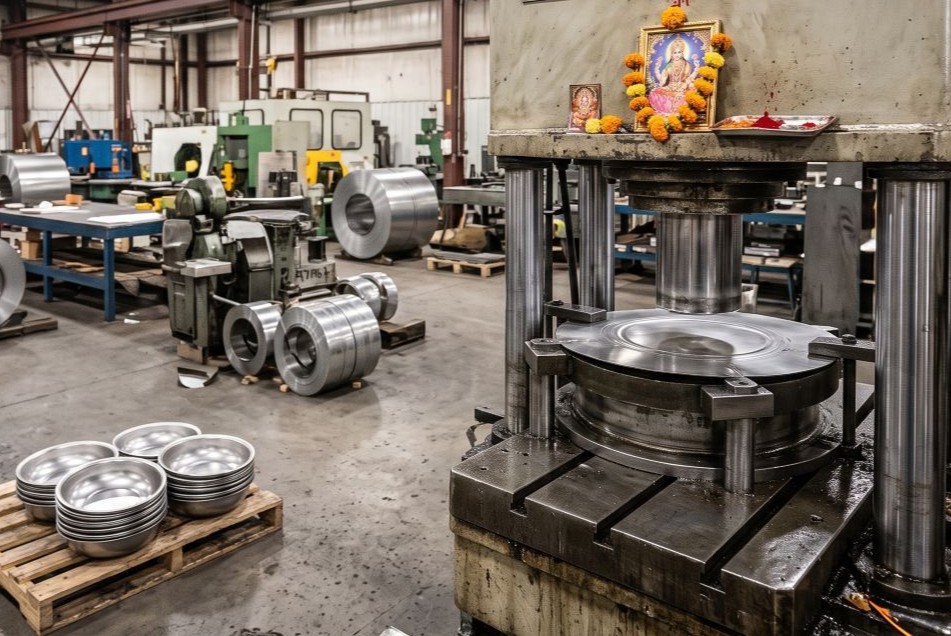
The blank is placed over a circular die, a hardened steel tool with a cavity in the shape of the desired product and a punch is pressed downward through the blank into the die cavity. As the punch descends, the metal of the blank is drawn inward and downward, flowing over the die’s edge radius (called the die radius) and forming the walls of the bowl or container. A blank holder or pressure plate holds the outer rim of the blank with controlled force to prevent it from wrinkling as the metal flows.
This is the most technically demanding step in the process. The punch must apply enough force to draw the metal into shape, but not so much that it tears through the base of the forming component. The die radius must be large enough to allow the steel to flow without cracking, but tight enough to achieve the desired wall depth. Lubrication between the blank and the die is essential to reduce friction and prevent galling or surface damage on the steel.
For deeper shapes, such as tall canisters or deep-bodied containers, a single drawing operation may not be sufficient. The blank is drawn to an intermediate depth in the first operation, annealed (heat-treated to relieve stress and restore ductility), and then drawn again in a second or third operation to achieve the final depth. Each redraw operation gradually deepens the form while maintaining structural integrity.
Step 4: Annealing Between Draws
Annealing is the process of heating the steel to a specific temperature and then cooling it in a controlled manner to relieve the internal stresses that accumulate during drawing. Each time stainless steel is mechanically deformed, it work-hardens, becoming stiffer and less ductile. If not annealed between draws, the steel can crack or fracture in subsequent operations. Annealing essentially resets the material’s mechanical properties, allowing it to be drawn further without failure.
The number of anneal cycles required depends on the complexity and depth of the finished product. Simple shallow bowls or thalis may require no intermediate annealing, while deep dabbas or complex multi-tier containers may go through two or three draw-and-anneal cycles.
Step 5: Trimming and Edge Finishing
Once the desired shape is achieved, the top edge of the drawn form is rarely perfectly uniform, the metal tends to form slight irregularities called ears or earing, caused by the directional properties of the rolled sheet. A trimming press removes the excess material from the rim to produce a clean, uniform edge.
Edge finishing, whether through rolling, beading, or smooth radiusing, then removes any sharpness from the trimmed rim. This step is critical for food-contact products. A sharp or poorly finished rim is both a safety issue and an indicator of lower manufacturing quality. Well-finished edges on stainless steel kitchenware should be smooth to the touch with no rough burrs or sharp transitions.
Step 6: Surface Treatment and Polishing
The drawn component goes through a series of surface treatments depending on the finish specification. Pickling, using a mild acid solution, removes surface scale, heat tint and contaminants from the annealing operations, restoring the clean stainless steel surface. Passivation may follow to reinforce the chromium oxide layer that gives stainless steel its corrosion resistance.
Polishing is typically the final step before inspection. The level of polish determines the surface finish of the finished product. A mirror polish (bright, reflective finish) is the most demanding to achieve and is commonly associated with premium kitchenware and tableware. A satin or matte finish is produced through a different abrasive process and is often used for products where fingerprints and surface marks need to be less visible.
Step 7: Quality Control and Inspection
Finished components are inspected for dimensional accuracy (diameter, depth, wall thickness), surface quality (no scratches, pits, or scale marks), edge finish, and overall form. For kitchenware manufactured to BIS standards in India, additional tests including staining tests, thermal shock tests for multi-layer products, and mechanical shock tests are conducted. Only products that pass these checks move to packaging and dispatch.
How Deep Drawing Shapes Specific Indian Utensils
Thalis and Trays
A stainless steel thali is a shallow, large-diameter drawn form. The blank for a standard-size thali may be 400 mm or more in diameter, and the drawing operation produces a wide rim and a relatively shallow central depression with defined rim geometry.
The large surface area of a thali requires careful blank holder pressure management to prevent wrinkling at the periphery during drawing. Premium thalis may have an additional beading or raised rim detail that is formed in a separate operation after the main draw. Well-manufactured stainless steel thali and tray products will have consistent wall thickness, perfectly smooth inner surfaces, and cleanly finished rims without roughness.
Katoris and Bowls
Katoris and bowls are among the most commonly deep-drawn stainless steel products. Their depth-to-diameter ratio is typically between 0.4 and 0.7, which makes them suitable for a single-draw operation in most cases. The key quality variable in a katori is the consistency of wall thickness, a well-drawn katori will have walls of even thickness from base to rim, with no thinning or weak spots that might deform under heat or pressure.
Dabbas and Canisters
Stainless steel dabbas and canisters are among the most technically demanding products to produce by deep drawing because of their combination of depth, cylindrical walls, and the requirement for matching lids that seal precisely. The body of a deep canister may require two or three sequential drawing operations with annealing in between.
The lid is drawn separately and must be matched in diameter to achieve the correct fit. Airtight or press-fit lids require particularly tight dimensional tolerances in both the body and lid forming operations. The quality of a dabba is evident in how smoothly and consistently the lid fits, a loose, ill-fitting lid is a sign of inadequate dimensional control at the manufacturing stage.
How Deep Drawing Affects the Quality of the Finished Utensil
The quality of deep drawing directly determines several attributes that consumers notice in finished stainless steel utensils, even if they do not consciously attribute them to the manufacturing process.
Wall thickness uniformity: A well-drawn utensil has consistent wall thickness throughout. Thin spots in the walls are a sign of over-drawing or poor blank selection, and create structurally weak areas that may deform with use.
Base strength: The base of a drawn bowl or katori should be flat and rigid. A base that bows or flexes when pressed indicates inadequate gauge or a drawing process that has over-thinned the base section.
Rim finish: The quality of edge trimming and rim finishing is one of the most visible indicators of manufacturing quality. Smooth, rolled, burr-free rims indicate careful finishing; rough or sharp rims indicate shortcuts in this stage.
Surface uniformity: Die marks, scratches, or inconsistent polish on the inner surface of a drawn utensil suggest either poor lubrication during drawing or inadequate surface finishing. Inner surfaces of food-contact utensils should be smooth and consistent.
Seam-free construction: The defining advantage of deep drawing is the absence of any weld, joint, or seam. If you notice any line, ridge, or discolouration running vertically up the wall of a supposedly drawn product, it may have been formed by a different process, such as welding a flat strip into a cylinder. For food-contact products, seamless construction is always preferable.
Why Deep Drawing is Preferred Over Welding or Casting for Kitchen Utensils
There are alternative ways to make hollow steel containers, rolling and welding a flat strip into a cylinder, or casting molten metal into moulds, but deep drawing offers specific advantages that make it the preferred method for quality stainless steel kitchenware.
Welded seams, even when well-executed, create potential weak points and sites for bacterial accumulation if the finish is not perfect. In food-contact applications, seamless is always the safer and more hygienic choice.
Casting, while capable of producing complex shapes, is not practical for thin-walled stainless steel kitchenware at scale, it is more suited to heavy iron or brass cookware. Deep drawing produces parts with consistent wall thickness, superior surface finish potential, and no joints, which is why it has been the standard manufacturing method for stainless steel kitchenware globally for decades.
From a production efficiency standpoint, deep drawing is also highly scalable. Once the dies are made and the process parameters are set, the same die set can produce thousands of identical components per day, making it suitable for the volume requirements of manufacturers supplying both domestic and export markets.
What Deep Drawing Quality Tells You About a Manufacturer
Deep drawing requires significant capital investment in precision tooling, presses, and surface treatment equipment. Manufacturers who invest in quality deep drawing infrastructure produce noticeably better products, more consistent, better finished, and more durable. This investment is also evident in their ability to maintain tight dimensional tolerances across large production runs, which matters especially for products like dabbas where lids and bodies must match precisely.
When evaluating stainless steel kitchenware, whether for personal purchase or business procurement, looking at the evidence of the drawing process is a useful quality check. Pick up the product and feel the walls: are they consistent in thickness? Check the rim: is it smooth and rounded, or rough and sharp? Look at the inner surface: is it evenly polished, or does it show tool marks and inconsistencies? These details reveal the quality of the manufacturing process behind the product, much of which comes back to the care taken at each stage of deep drawing.