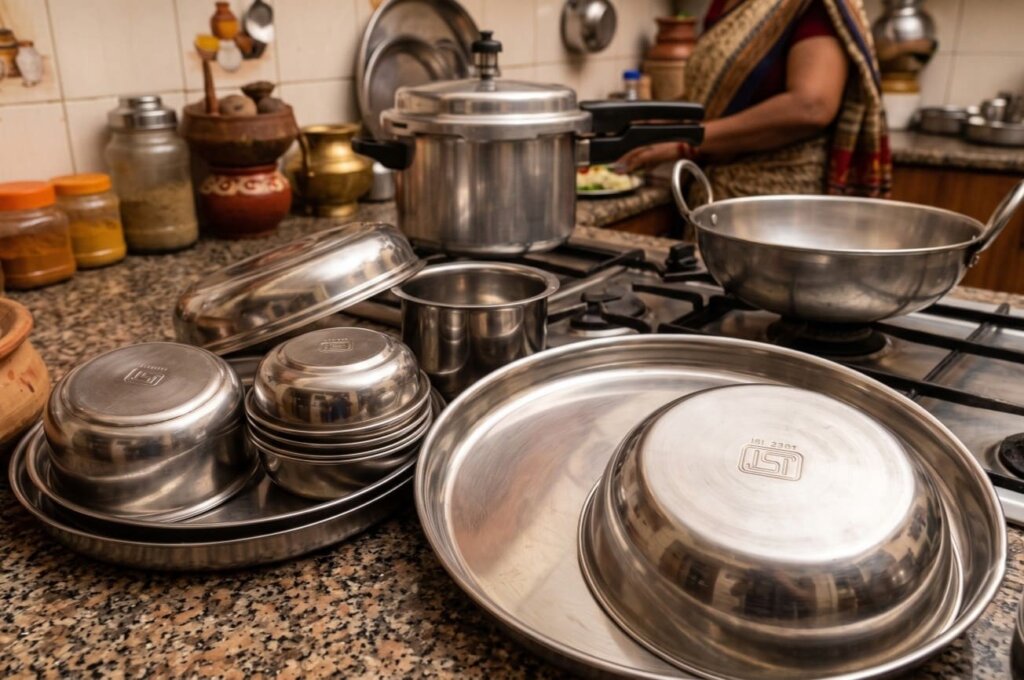
Walk into any kitchen supply market in India and you will see thousands of stainless steel utensils displayed across shops and stalls, thalis in every size, katoris of every gauge, dabbas with tight-fitting lids, and spoons in every shape. Most buyers pick up these items, check the weight and finish, compare the price, and make a purchase. Very few look for a small mark on the base of the product that tells them a great deal more about what they are actually buying.
That mark is the ISI mark, issued under the Bureau of Indian Standards (BIS) certification framework, and since 2024 it has become mandatory for all stainless steel utensils sold in India. Whether you are a consumer trying to make a safer buying decision, a bulk procurement manager sourcing kitchenware for institutional use, or simply curious about what separates quality-verified steel products from unverified ones, understanding BIS certification is increasingly important.
This guide explains what BIS certification means for stainless steel utensils, what the relevant Indian Standard covers, how the certification process works, what the ISI mark tells you as a buyer, and why this matters now more than ever in the Indian kitchenware market.
What is BIS and What is its Role in the Kitchenware Industry?
The Bureau of Indian Standards is the national standards body of India, operating under the Ministry of Consumer Affairs, Food and Public Distribution. Established under the Bureau of Indian Standards Act, BIS develops and maintains Indian Standards (IS) for thousands of product categories, from construction materials and electrical goods to food contact products and kitchenware.
BIS operates a product certification scheme under which manufacturers can apply for a license to use the ISI mark on their products. The ISI mark (short for Indian Standards Institute, the predecessor body to BIS) signals that a product has been tested against a specific Indian Standard and found to conform to its requirements. For the product to carry the mark, the manufacturer must hold a valid BIS license, which is granted only after product testing in a BIS-recognized laboratory and an inspection of the manufacturing facility.
In many product categories, BIS certification is voluntary. However, the government has the authority under the BIS Act and through Quality Control Orders (QCOs) to make certification mandatory for specific products where consumer safety is a concern. For stainless steel utensils, this is now exactly the case.
The Quality Control Order That Made BIS Certification Mandatory for Steel Utensils
The Government of India, through the Department for Promotion of Industry and Internal Trade (DPIIT) under the Ministry of Commerce and Industry, issued the Cookware, Utensils, and Cans for Foods and Beverages Quality Control Order in 2024. This order mandated BIS certification for stainless steel utensils under the Indian Standard IS 14756, making the ISI mark compulsory for all such products manufactured, sold, imported, or distributed in India.
The mandate was further reinforced when a revised Quality Control Order was notified in the Official Gazette on 21 August 2025. From the implementation dates specified in that order, stainless steel utensils without a valid BIS license cannot legally be manufactured, sold, distributed, stored, hired, leased, or exhibited for sale anywhere in India. The prohibition extends to imports as well: stainless steel utensils cannot be imported unless they carry a valid BIS license and the ISI mark.
The government staggered the implementation timelines to give manufacturers of different sizes adequate time to comply. Large enterprises were required to comply first, followed by small enterprises, and then micro enterprises. This phased approach was intended to avoid disruption while progressively raising the quality floor across the entire market.
Who is Covered Under This Order?
Indian manufacturers producing stainless steel utensils for the domestic market are required to obtain BIS certification before their products can be sold.
Importers cannot import stainless steel utensils unless each product carries a valid BIS license and ISI mark.
Foreign manufacturers who export stainless steel utensils to India must also obtain BIS registration and comply with the requirements of Scheme I of BIS certification regulations.
Traders and packers who buy utensils and repack them under their own brand names are not granted BIS licenses themselves but must ensure that every individual utensil they source already carries the ISI mark with a valid BIS license number. The packaged set must carry appropriate markings confirming it contains ISI-marked products.
Who is Exempt?
Domestic exporters who manufacture stainless steel utensils exclusively for export and do not sell in the Indian domestic market are not required to obtain BIS certification for those export products. Importers bringing in small quantities of utensils specifically for research and development purposes are also exempt from the mandatory certification requirement, subject to quantity limits and the condition that the goods are not sold commercially. Old stock manufactured or imported before the implementation date may be sold for a defined period, subject to conditions.
What is the Indian Standard IS 14756?
IS 14756 is the Indian Standard that defines the requirements for stainless steel utensils. Developed by BIS, it specifies the technical criteria that a stainless steel utensil must meet in order to be considered safe, functional, and of acceptable quality for use in cooking, serving, dining, and food storage applications.
The standard has been updated over time, with the most recent revisions being IS 14756:2022 and IS 14756:2024. The core substance of the standard remains consistent: it sets out the material composition requirements for the steel used, dimensional and workmanship criteria for the finished product, and a battery of performance tests that the product must pass.
Understanding what IS 14756 actually covers gives a much clearer picture of what the ISI mark on a stainless steel utensil actually guarantees.
Material Requirements
IS 14756 specifies that the stainless steel used in utensil manufacturing must conform to IS 5522, the Indian Standard for stainless steel sheets and strips for utensils, or to IS 15997, the Indian Standard for low nickel austenitic stainless steel sheets and strips for utensils and kitchen appliances. Both of these raw material standards are themselves under compulsory BIS certification under a separate Quality Control Order issued by the Ministry of Steel.
This creates a traceability chain: the steel sheet used to make the utensil must come from a BIS-certified mill, the semi-finished or finished utensil must be made by a BIS-licensed manufacturer, and the finished product must carry the ISI mark. A manufacturer seeking BIS certification for their utensils must supply test certificates for each consignment of raw material to demonstrate that the steel used meets the required grade specifications.
This material requirement is significant for buyers because it addresses one of the most common quality issues in the lower end of the Indian stainless steel market: the use of unspecified or substandard steel grades that may have inconsistent composition, higher impurity levels, or inadequate corrosion resistance.
By anchoring the standard to specific verified grades of raw material, IS 14756 establishes a minimum quality floor at the very start of the supply chain. For a deeper look at how different stainless steel grades compare in terms of composition and suitability for Indian kitchenware, the comparison of stainless steel grades used in Indian kitchenware is a useful reference.
Shapes, Dimensions, and Workmanship
Beyond material composition, IS 14756 specifies requirements for the physical form of utensils. This covers standard dimensions for common utensil types, ensuring that products labelled with a particular size or capacity actually conform to that specification. For consumers and institutional buyers who procure matching sets or need to replace individual pieces within a set, dimensional consistency matters practically.
The workmanship provisions of the standard address the quality of manufacturing visible in the finished product. Sharp edges, rough rims, surface defects such as pits or scale marks, and inconsistent finishing are all covered. A BIS-certified product must meet the workmanship standards laid out in IS 14756, which means the manufacturer is required to maintain quality controls at the production stage that prevent these defects from reaching the market.
The Performance Tests Under IS 14756
The performance testing requirements of IS 14756 are the most technically demanding aspect of BIS certification for stainless steel utensils. These tests simulate real-world use conditions and check whether the product maintains its integrity, safety, and appearance under those conditions. The key tests mandated by the standard include:
Staining test: This test assesses how the stainless steel surface responds to common food acids and staining agents under controlled conditions. A product that passes the staining test demonstrates that its surface finish and steel grade provide adequate resistance to the kinds of foods and liquids it will encounter in typical Indian cooking. Tamarind, tomato, lemon, and other acidic ingredients used widely in Indian cuisine are particularly relevant to this assessment.
Mechanical shock test: For multi-layer or clad products, this test checks whether the bonding between different layers of material can withstand physical impact without delamination or failure. It ensures that composite base products, such as those with a sandwich bottom or a tri-ply construction, maintain structural integrity under conditions of normal use including accidental drops or impacts.
Thermal shock test: This test subjects the utensil to rapid and extreme temperature changes to check whether the material and any multi-layer construction can withstand thermal stress without cracking, warping, or delamination. It is particularly relevant for cookware used on gas flames or induction stoves, where temperature changes can be sudden and significant.
Dry heat test: This test evaluates the performance of the utensil when subjected to high temperature without the presence of liquid or food. It is relevant for cookware that may be left on a heat source momentarily without contents, simulating a common real-world scenario that can expose quality issues in substandard steel or poorly bonded composite products.
Coating thickness test: For products with coatings, such as non-stick coatings or colour coatings applied over the steel base, this test verifies that the coating meets minimum thickness specifications and is applied uniformly. A coating that is too thin or unevenly applied may peel, flake, or fail prematurely, creating a food safety concern.
Nominal capacity test: This test confirms that utensils sold with a stated volume or capacity, such as a 2-litre degchi or a 500 ml katori, actually meet the stated capacity within acceptable tolerances. This protects buyers from misrepresentation on product labelling.
Flame stability test: This test checks the stability of a utensil when placed on a standard gas burner. A product must be stable and not tip or wobble in a way that would constitute a safety hazard during normal cooking use.
Tempered glass lid tests: For utensils sold with tempered glass lids, additional specific tests apply to the lid to verify its thermal resistance, impact resistance, and fit on the utensil body.
The ISI Mark: What it Looks Like and What to Check
The ISI mark is a round mark featuring the letters ISI in a stylised form, with the relevant Indian Standard number (for stainless steel utensils, IS 14756) typically shown alongside or beneath the mark. Critically, every genuine ISI mark is accompanied by a unique 7 to 10 digit BIS license number that identifies the specific manufacturer who has been granted certification.
This license number is the most important element to verify when checking whether an ISI mark is genuine. A product displaying the ISI logo without a visible license number may be carrying a counterfeit or misused mark. Fake ISI marks, unfortunately, are not uncommon in the Indian market, and some unscrupulous traders use the visual appearance of the mark without having gone through the certification process.
How to Verify an ISI Mark on a Stainless Steel Utensil
The BIS operates an online verification portal where the license number on a product can be checked against the central BIS database to confirm that the license is valid and active. A consumer or buyer who wants to verify an ISI mark they have seen on a utensil can enter the license number on the BIS website and see the registered details of the licensed manufacturer. Verify the ISI Mark on your Stainless Steel Utensils here –
Additionally, reputable manufacturers display the BIS license number clearly on each individual utensil as well as on the outer packaging. When buying a set of stainless steel kitchenware or tableware, checking that each piece in the set carries the stamped ISI mark and the license number is a practical step to confirm compliance. A set where only the outer box carries the mark but the individual pieces do not is not fully compliant with the QCO requirements.
Why BIS Certification Matters for Consumers in India
Protection From Substandard and Potentially Unsafe Steel
The most important reason BIS certification matters for consumers is protection from substandard steel that could pose health risks. In the absence of mandatory standards, a significant portion of the Indian stainless steel utensil market was supplied by products made from unspecified steel grades with variable composition. Some of these products contained higher levels of impurities or used steel grades with lower nickel and chromium content that provide inadequate corrosion resistance.
When low-quality steel corrodes or interacts with acidic foods over time, it may leach trace metals into the food. For daily-use items that come into contact with the food of every family member at every meal, this is a meaningful health consideration. The IS 14756 standard directly addresses this by requiring that the raw material used conform to verified steel grade specifications, and the staining test confirms the finished product’s performance under food contact conditions.
Assurance of Dimensional Accuracy and Workmanship
BIS certification also means that the product has been checked for dimensional accuracy and workmanship quality. For consumers who buy matching sets of katoris, thalis, or dabbas and expect the pieces to be consistent in size and finish, the certification process provides a level of assurance that the manufacturer is maintaining production controls capable of delivering that consistency. Sharp rims, rough edges, and inconsistent finishes that are common in uncertified products are specifically addressed by the workmanship requirements of IS 14756.
Recourse If a Product Fails
When a consumer purchases a certified ISI-marked product and finds that it does not perform as the standard requires, they have a formal avenue for complaint. BIS accepts complaints from consumers about ISI-marked products, and a genuine complaint triggers an investigation into the licensed manufacturer’s product. This legal framework gives ISI-marked product buyers a form of recourse that purchases of non-certified products do not have. The manufacturer’s license can be suspended or revoked if products are found to be consistently non-compliant.
Informed Buying in a Crowded Market
India’s stainless steel utensil market is large, fragmented, and highly competitive. Products from hundreds of manufacturers in cities like Rajkot, Ahmedabad, Mumbai, and Yamunanagar reach buyers across the country through wholesale markets, retail chains, and online platforms. In this environment, price is often the primary differentiator, and quality differences between products are not always visible to the naked eye.
The ISI mark gives buyers a simple, verifiable shortcut to quality assurance. When comparing two stainless steel tiffins or a pair of thali sets at different price points, the presence of a genuine ISI mark with a verifiable license number on one product is a meaningful signal that the certified product has cleared a set of tested quality requirements that the uncertified one has not. For institutional buyers sourcing kitchenware for hospitals, school mid-day meal programmes, canteens, or corporate gifting in bulk, this distinction is particularly important.
Why BIS Certification Matters for Manufacturers and the Industry
Legal Compliance and Market Access
For any manufacturer supplying the Indian domestic market, BIS certification is now a legal prerequisite, not an optional quality credential. Operating without a valid BIS license exposes a manufacturer to seizure of stock, significant financial penalties, and legal action under the BIS Act 2016. The prohibition covers not just the sale but also the manufacture, storage, and distribution of non-compliant products, which means that the risk extends across the entire supply chain.
For manufacturers who supply to organised retail chains, institutional buyers, or export-oriented wholesale buyers, the certification is increasingly a baseline requirement for even being considered as a supplier. Buyers in these segments have their own compliance obligations and will not risk sourcing from uncertified manufacturers.
A Level Playing Field Against Imports
The mandatory BIS requirement for imported stainless steel utensils is a significant development for Indian manufacturers. Previously, imported utensils, particularly from China and other Asian manufacturing centres, could enter the Indian market without meeting the same quality standards that Indian manufacturers were voluntarily adhering to. The mandatory QCO changes this: foreign manufacturers must now either obtain BIS certification or their products cannot legally be imported and sold in India.
This creates a level playing field where domestic manufacturers who have invested in quality infrastructure and BIS compliance are not undercut by cheaper imported products that do not meet the same standards. It also incentivises foreign manufacturers who want continued access to the Indian market to align with Indian quality requirements.
Quality Infrastructure and Continuous Improvement
Obtaining and maintaining BIS certification requires manufacturers to invest in testing equipment, quality control processes, and factory management systems. The BIS license is not a one-time award: it is subject to surveillance audits and renewal, with BIS conducting periodic checks to ensure that certified manufacturers continue to produce products that meet the standard. This ongoing compliance requirement incentivises manufacturers to maintain quality systems rather than allowing standards to slip after the initial certification is obtained.
For manufacturers with long-term reputations built on product quality, the BIS certification framework provides a structured mechanism to document and demonstrate the quality of their manufacturing processes. For stainless steel kitchenware and tableware manufacturers serving both domestic and export customers, this is an investment in credibility as much as in compliance.
How the BIS Certification Process Works for Manufacturers
For manufacturers seeking to obtain BIS certification for their stainless steel utensils under IS 14756, the process follows a defined sequence under Scheme I of the BIS Conformity Assessment Regulations.
Step 1: Application Submission
The manufacturer submits an application in the prescribed form (Form V) to BIS through the official online portal. The application includes company registration details, factory location, product details specifying the types and grades of utensils to be covered under the license, and details of in-house testing facilities. Manufacturers are required to have a minimum level of in-house testing capability to be considered for certification.
Step 2: Document Submission
Along with the application, the manufacturer provides a set of supporting documents including factory registration and business licenses, quality management system documentation, raw material traceability records including test certificates from BIS-certified steel mills, product technical specifications, and samples for testing.
Step 3: Product Testing in a BIS-Recognized Laboratory
Product samples submitted by the applicant are tested in a laboratory recognized by BIS against all the relevant requirements of IS 14756. This includes the material tests, dimensional checks, and the full battery of performance tests described earlier. The test results determine whether the product meets the standard. If the product fails any test, the manufacturer must address the issue before the certification process can proceed.
Step 4: Factory Inspection and Audit
BIS officers conduct a physical inspection of the manufacturing facility to assess whether the factory has the infrastructure, equipment, and quality management systems needed to consistently produce the certified product. The inspection covers raw material receipt and storage, production processes, in-house testing capabilities, calibration of test equipment, and record-keeping systems. A factory that can only produce compliant products in a one-time batch for testing but cannot sustain that quality in regular production will not be granted a license.
Step 5: Grant of License
If the product testing and factory inspection are satisfactory, BIS issues a certification license granting the manufacturer the right to affix the ISI mark on the specified products. The license comes with a unique license number that must be stamped on each certified product alongside the ISI mark. For Indian manufacturers, the standard timeframe from application to license grant is approximately 30 days, though this can vary based on application completeness and BIS workload. For foreign manufacturers, the timeframe is significantly longer, typically around 180 days.
Step 6: Ongoing Surveillance and Renewal
The BIS license is valid for a specified period and is subject to renewal. During the license period, BIS conducts surveillance visits to the factory to check that production continues to meet the certified standard. Samples may be collected from the market and tested independently. If BIS finds that a licensed manufacturer is producing non-compliant products, the license can be suspended or cancelled and the manufacturer faces legal consequences. This ongoing oversight is what gives the ISI mark its value: it is not a one-time stamp but a continuously maintained credential.
BIS Certification and Its Connection to Other Quality Markers
BIS certification under IS 14756 exists alongside other quality indicators that buyers of stainless steel utensils encounter. Understanding how BIS relates to these other markers helps build a more complete picture of quality assurance in the stainless steel kitchenware space.
BIS Certification vs Steel Grade Stamps
Steel grade stamps such as 18/8, 18/10, or SS 304 on the base of a utensil communicate the composition of the steel alloy used. BIS certification, on the other hand, confirms that the finished product as a whole has been tested and found to meet a comprehensive performance standard that goes beyond raw material specification. A product can be made from good quality Grade 304 steel and still have poor workmanship, incorrect dimensions, or inadequate surface finish. BIS certification checks all of these dimensions, not just the material grade.
Conversely, a BIS-certified product must, by requirement, use steel that conforms to IS 5522 or IS 15997, which themselves have defined composition requirements. So BIS certification provides an implicit assurance of the steel grade as well, since non-compliant raw material would cause the product to fail IS 14756’s requirements. For those interested in how different steel grades compare, the detailed guide on stainless steel grades used in Indian kitchenware covers this in depth.
BIS Certification and Food Safety Standards
BIS certification under IS 14756 addresses the food safety aspects of stainless steel utensils from the perspective of material safety and physical performance. It ensures that the utensil will not contaminate food through material leaching under normal use conditions and that the product’s surface finish is suitable for food contact.
This overlaps with but is distinct from food safety standards such as those issued by FSSAI, which address the safety of food products themselves. For manufacturers and buyers who need to ensure full food safety compliance across their supply chain, BIS certification for the utensil is one important layer in a broader quality framework.
What to Look for as a Buyer of Stainless Steel Utensils After the QCO
For consumers and procurement buyers in India, the mandatory BIS certification regime introduced by the QCO 2024 and 2025 changes the landscape of what to look for when purchasing stainless steel utensils. Here is a practical guide to evaluating products in the current environment.
Check for the ISI mark on the product itself, not only on the packaging. Every individual utensil should carry the stamped or embossed ISI mark and the BIS license number. A set where only the outer box carries the mark but the individual thalis, katoris, or spoons do not is not fully compliant.
Verify the license number through the BIS online portal if you want to confirm the mark is genuine. The license number is specific to the manufacturer, and a quick check confirms that it is active and registered to a legitimate company.
Be cautious of products priced significantly below market norms, particularly if they lack a visible ISI mark or display an ISI logo without a license number. The price difference often reflects the cost savings from not investing in BIS certification, which in turn reflects shortcuts in raw material quality, manufacturing, or testing.
For institutional procurement, require suppliers to provide copies of their BIS license as part of the qualification process. A licensed manufacturer can produce their certificate on request, which confirms the specific products and grades covered under the license.
When sourcing stainless steel kitchenware, stainless steel thali and tray sets, stainless steel spoons and cutlery, stainless steel dabbas and canisters, or stainless steel tableware sets for bulk or commercial use, specifying BIS-certified products provides a verifiable quality baseline that is legally anchored and independently tested.
The Broader Impact of Mandatory BIS Certification on the Indian Stainless Steel Utensil Market
The mandatory BIS certification framework represents one of the most significant regulatory developments in the Indian stainless steel kitchenware industry in recent decades. Its effects extend beyond individual product compliance to reshape the competitive landscape of the industry.
At the consumer end, mandatory certification raises the quality floor for every product sold in the Indian market. Products that could previously be sold purely on the basis of low price, without any verified quality standard, can no longer legally enter the market without meeting IS 14756 requirements. Over time, this should reduce the prevalence of visibly substandard products and give consumers greater confidence that any product they buy in a shop or online meets a minimum independently verified quality standard.
At the manufacturing end, the transition to mandatory certification accelerates a process of formalisation and quality investment that has been underway in parts of the industry for years. Manufacturers who had already invested in quality infrastructure and were voluntarily maintaining higher standards are now on a level footing with competitors who were not. Manufacturers who had not invested in quality systems face the choice of doing so or exiting the domestic market.
For the Indian stainless steel utensil industry as a whole, the mandatory BIS certification regime strengthens the credibility of Made in India products both domestically and in export markets. Indian manufacturers who have obtained BIS certification under a mandatory government standard can point to that certification as evidence of independently verified quality when competing for export contracts or addressing quality concerns from international buyers.
Conclusion
BIS certification for stainless steel utensils in India is no longer a voluntary quality signal. It is a legal requirement for every manufacturer, importer, trader, and seller operating in the domestic market, anchored in the Indian Standard IS 14756 and enforced through the Quality Control Orders of 2024 and 2025.
For consumers, the ISI mark on a stainless steel utensil is a meaningful assurance that the product has been tested against a comprehensive set of material, workmanship, and performance requirements. Checking for the mark and verifying the license number are simple steps that any buyer can take to make more informed purchasing decisions in a market where quality differences are not always visible at a glance.
For manufacturers, compliance is both a legal obligation and a business investment in credibility. The certification process, while requiring effort and infrastructure, builds a foundation of documented quality that serves long-term business interests alongside regulatory requirements.
Understanding what BIS certification covers and why it was introduced helps everyone involved in the stainless steel kitchenware supply chain, from the factory floor to the family kitchen, make better decisions about the products that come into contact with food every single day.