Walk into any kitchenware shop in India, whether it is a small hardware store in a small town or a wholesale market in a city like Mumbai, and you will find thalis labelled by inch size with very little explanation of what those numbers mean for actual use. A shopkeeper might set out a 10 inch thali, a 13 inch thali and an 18 inch platter side by side, leaving a first time buyer, whether furnishing a new home kitchen or setting up a hostel mess, unsure which one actually suits their need.
Thali sizing in India is not governed by a single fixed standard the way some packaging or safety specifications are. Instead, sizes have settled into a set of conventions shaped by how the plate is actually used: how many dishes are served on it at one time, whether it holds a full meal for a single person or is shared across a table, how it is stacked and stored between uses, and whether it needs to survive repeated commercial dishwashing in a hotel kitchen or gentle handwashing at home.
This article sets out the size ranges that have become standard across three broad settings, home kitchens, hotels and restaurants, and dhabas, along with the regional variations in shape and compartment design that also influence what size makes sense for a given kitchen. It also looks at how thickness, usually described by gauge number, works alongside diameter to determine how well a thali holds up over years of daily use.
Why Thali Size Depends on Where It Is Used
The most basic factor behind thali size is portion format. A thali meant to carry an entire meal for one person, rice, two or three sabjis in katoris, dal, roti, salad and a sweet, needs more surface area than a plate that is only used to serve one item at a time. This is why a home thali used for daily meals is often smaller than a thali used in a restaurant that serves a full course spread with several small bowls arranged around it.
The second factor is how the thali is handled outside of the meal itself. A hotel or dhaba buys thalis in bulk, stacks dozens of them at a time in a narrow shelf space, and runs them through the same wash cycle several times a day. A slightly larger or heavier thali that would feel unwieldy in a two person home kitchen is entirely normal in a commercial setting, where stacking height and wash cycle durability, not individual handling, drive the choice of size and gauge.
Standard Thali Sizes for Home Use
For household use, thali size is largely a function of family size and how many items are typically served together. A home kitchen rarely needs more than one or two thali sizes in circulation, often supplemented with matching stainless steel serving spoons and katoris for the family to share, rather than the wide range of sizes a commercial buyer might stock.
10 to 12 Inch Thalis for Daily Meals
Thalis in the 10 to 12 inch range are common for everyday lunch and dinner in smaller households, particularly where the meal is served in stages rather than all at once, such as roti and sabji first followed by rice and dal. This size is also popular for children’s meals and for households that prefer smaller, more frequently refilled portions over one large spread.
Plates in this range are usually lighter in gauge as well, since they are handled individually rather than stacked in large commercial quantities, and a lighter thali is easier to manage for daily handwashing. Many households also keep a 10 inch thali specifically for guests or for serving snacks during festive gatherings, separate from the thali used for main meals.
The 13 Inch Thali, the Most Common All Purpose Size
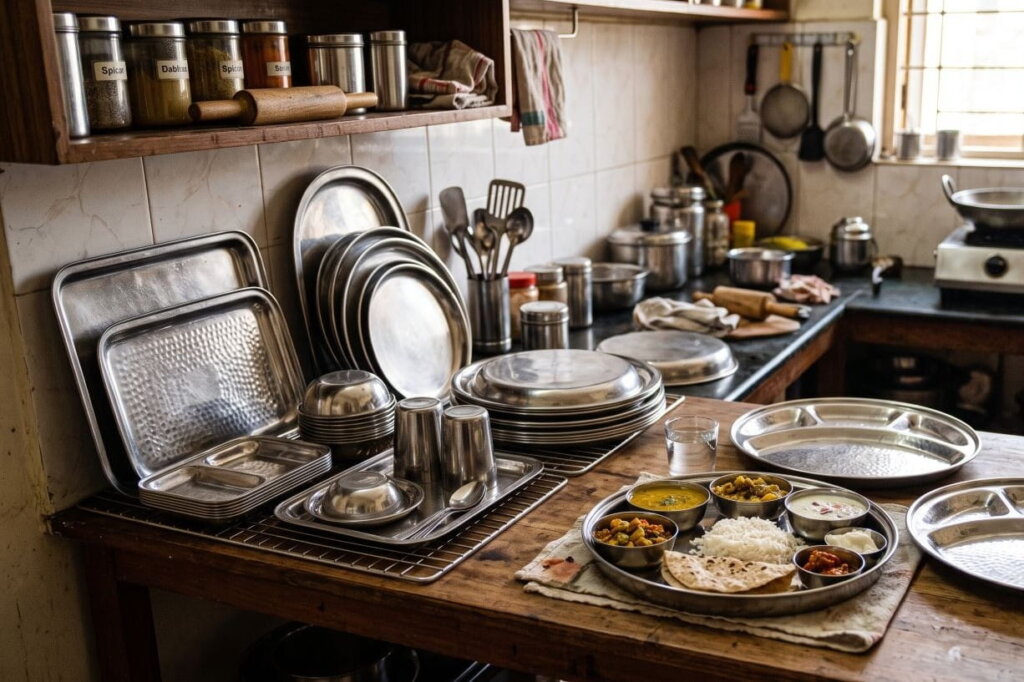
The 13 inch thali is the size most frequently found across Indian homes and is generally treated as the standard dinner size. It comfortably holds rice, two to three katoris of sabji and dal, a couple of rotis, and a small serving of pickle or salad without items running into each other, which is why it remains the default recommendation from most stainless steel thali and tray sets sellers when a customer has no specific requirement in mind.
Because it sits at the midpoint between compact daily use and the larger sizes needed for shared or festive meals, the 13 inch thali is also the size most commonly paired with a matching set of katoris, a small glass and a spoon to form a complete thali set sold as a single unit. This makes it a practical choice for households buying their first full set rather than individual pieces.
Compartment Thalis for Home Kitchens
Compartment thalis, sometimes called partition plates, divide the surface into three, four or five sections and are increasingly common in home kitchens that want to serve a complete meal without using separate katoris for every item. These are typically available in the same 10 to 13 inch range as plain thalis, with the compartments reducing the effective surface area available for each item compared to a plain thali of the same diameter.
Compartment thalis are manufactured using a forming process capable of shaping several deep, well defined recesses into a single sheet of steel without weakening the metal at the bends, the same general manufacturing approach used across most everyday stainless steel kitchen products. Households that prefer portion control, or that serve children who benefit from visually separated food items, tend to gravitate toward this format even at the smaller end of the size range.
Thali Sizes Used in Hotels and Restaurants
Commercial kitchens work with a wider spread of thali sizes than home kitchens because a single establishment often needs different sizes for different service formats: individual thali service at the table, buffet platters for self service lines, and oversized platters for special or festive spreads. Bulk buyers for hotels and restaurants also weigh cost per piece more heavily, since even a small difference in size or gauge is multiplied across an order of hundreds of pieces.
13 to 16 Inch Thalis for Regular Dining Service
For standard sit down thali service, most restaurants use thalis in the 13 to 16 inch range, large enough to hold five or six katoris of curries, dal and accompaniments arranged around a central portion of rice, along with space for roti or puri at the edge. This range is common across vegetarian thali restaurants in western and northern India, where the entire meal is presented on one large steel plate accompanied by small bowls.
Restaurants serving Gujarati and Rajasthani thalis in particular tend to favour the upper end of this range, since these meal formats typically include a larger number of individual dishes served simultaneously compared to a simpler two or three item home meal. A restaurant that fills a 16 inch thali with six or more katoris needs the additional surface area simply to keep the bowls from overlapping.
18 to 20 Inch Serving Platters
Platters in the 18 to 20 inch range are generally used as serving pieces rather than individual eating plates, placed at the centre of a table or buffet line to hold shared items such as biryani, pulao or a whole tandoori preparation that guests then portion out themselves. Hotels also use this size for banquet and catering setups where food needs to be displayed attractively before being served.
Because these larger platters are handled less frequently per meal than individual thalis, kitchens tolerate a somewhat heavier gauge here without it becoming a practical inconvenience, and the extra weight actually helps the platter sit flat and stable when loaded with food during a buffet service. Establishments that also stock stainless steel dinner sets and tableware for individual place settings typically size their serving platters in this range specifically so the two work well together on the same table.
Large Format Platters for Buffets and Special Occasions
At the top end of the size range, platters between 24 and 36 inches in diameter are used for occasions where food is meant to be shared across a large group, such as wedding buffets, festival community meals, or restaurants offering the oversized sharing platters that have become popular for biryani and mandi style service in recent years. These sizes are less about individual portioning and more about visual presentation and communal serving.
Handling a platter this large requires two hands and a fair amount of counter space, so hotels and event caterers that stock these sizes usually keep them in limited numbers reserved specifically for the occasions that call for them, rather than as part of everyday table service. The gauge on these large platters also needs to be heavier than smaller thalis of the same material, since a thin sheet of steel at 30 inches or more in diameter will flex and bend under its own weight even before any food is placed on it.
Thali Sizes at Dhabas and Roadside Eateries
Dhabas and highway eateries operate under different pressures than either home kitchens or full service restaurants. Turnover is high, washing happens quickly between customers, and thalis are stacked in tall piles between meal rushes, so the size chosen tends to favour practicality over presentation. Most dhabas settle on thalis in the 12 to 14 inch range, large enough to hold a full meal of dal, one or two sabjis, roti and rice without needing a wide table setting, but compact enough to stack quickly and wash in large batches.
Because dhaba thalis go through heavier daily use than home thalis, often several hundred cycles of serving and washing every week, they are typically specified in a heavier gauge than a home thali of the same diameter, even though the two might look identical in size on a shelf. Dhaba owners buying in bulk also tend to prioritise a plain, undecorated design over compartment or embossed styles, since a flat surface without recesses is faster to clean and less likely to trap food residue during a quick wash between customers.
Regional Variations in Thali Size and Shape
Beyond the broad home, hotel and dhaba categories, thali size and shape also vary by region, reflecting differences in how a full meal is traditionally composed and presented across India.
Maharashtrian and Gujarati Thali Styles
Maharashtrian thalis are frequently made with a slightly raised edge, sometimes described as a half inch rim, designed to keep liquid preparations like amti or kadhi from spilling over the side when the thali is filled with several katoris at once. These thalis commonly fall in the 12 to 13 inch range for home use and extend to 14 or 15 inches in restaurant settings that serve a traditional Maharashtrian thali meal with multiple courses.
Gujarati thali restaurants, known for serving a particularly large number of small dishes in a single sitting, often use the larger end of the standard range, 14 to 16 inches, specifically to accommodate the higher katori count that defines this style of meal. In both traditions, the thali functions less as a plate for a single dish and more as a base that organises an entire multi course meal on one surface.
South Indian Thali Sizes
South Indian meals, particularly the traditional full meals thali served in Tamil Nadu, Karnataka, Andhra Pradesh and Kerala, are often served on stainless steel plates in the 12 to 14 inch range, sometimes with a slightly deeper profile than the flatter thalis used in the north to accommodate rice, sambar, rasam and multiple side dishes served in small heaps directly on the plate rather than exclusively in separate katoris.
Restaurants serving South Indian meals during lunch service, particularly in Tamil Nadu and coastal Karnataka, also commonly use compartment plates in a similar size range, allowing multiple wet preparations like sambar and rasam to be served side by side without mixing, a practical solution given how many South Indian meal formats include several liquid or semi liquid dishes served at once.
Compartment or Bhojan Thalis for Institutional Use
Institutional settings such as school mid-day meal programmes, hospital canteens and industrial or corporate cafeterias generally favour compartment thalis, often called bhojan thalis, in sizes ranging from 10 to 16 inches depending on the number of items typically served. These settings prioritise portion control and food safety over presentation, since compartments help prevent cross contamination between dishes and make it easier to serve a standardised quantity to a large number of people quickly.
Mid-day meal programmes in particular tend to specify smaller compartment thalis in the 10 to 12 inch range suited to school age children, while hospital and corporate canteens more often use 13 to 14 inch compartment thalis that can accommodate a fuller adult meal across four or five separated sections.
Gauge and Thickness Alongside Size
Diameter is only half of what determines whether a thali will hold its shape over years of use. The other half is gauge, the measurement used in the Indian utensil trade to describe sheet thickness, where a lower gauge number indicates a thicker, heavier sheet of steel. A large thali made in a light gauge will flex and dent far more easily than a smaller thali of the same gauge, simply because there is more unsupported surface area for the metal to bend across.
This is why bulk buyers, particularly hotels and dhabas ordering thalis above 16 inches, are generally advised to specify a heavier gauge than they might choose for a smaller home thali, even when both pieces are made from the same grade of steel. Getting this pairing wrong, choosing a large diameter in a light gauge to save on cost, is one of the most common reasons a bulk order of thalis ends up warping or denting well before the steel itself would otherwise wear out.
How to Choose the Right Thali Size for Your Setup
Selecting the right thali size comes down to matching the diameter and gauge to how the plate will actually be used, rather than defaulting to whichever size is most commonly stocked by a local supplier. The following factors are worth working through before placing an order, particularly for bulk purchases where a wrong choice is expensive to correct.
- Number of dishes served together: a meal built around two or three items fits comfortably on a 10 to 13 inch thali, while a meal with five or more katoris, common in Gujarati and Rajasthani thali service, generally needs 14 inches or more to avoid overcrowding.
- Frequency of stacking and washing: settings that stack and wash thalis in large batches throughout the day, such as dhabas and hostel messes, benefit from a heavier gauge regardless of diameter, since the added weight resists denting during rough handling.
- Serving format: individual place settings call for a different size than shared serving platters, and a kitchen offering both should size these two categories separately rather than trying to use one size for everything.
- Storage space: taller stacks of larger thalis take up more vertical shelf space, which matters in compact kitchens and mess halls where storage is often the limiting factor rather than budget.
- Regional meal format: households and restaurants serving Maharashtrian, Gujarati or South Indian meals should account for the specific dish count and serving style typical of that cuisine rather than assuming a generic thali size will work equally well across all regional formats.
Conclusion
Thali size in India has never been fixed by a single formal standard, but decades of everyday use across homes, hotels and dhabas have settled the market into a fairly consistent set of ranges. Home kitchens generally work well with 10 to 13 inch thalis, restaurants serving full course meals move into the 13 to 16 inch range, serving platters for shared dishes sit between 18 and 20 inches, and the largest format platters, from 24 inches upward, are reserved for buffets and special occasions rather than everyday dining.
Regional meal formats add another layer of variation on top of these general ranges, with Maharashtrian, Gujarati and South Indian thali traditions each shaping preferences for size, rim height and compartment design based on how a full meal is typically composed in that cuisine. Institutional settings such as mid-day meal programmes and hospital canteens follow a somewhat different logic again, prioritising compartments and portion control over the flatter designs common in home and restaurant use. Ultimately, the right thali size for any kitchen, whether it serves two people or two hundred, depends less on picking the most popular size and more on matching diameter and gauge to how the plate will actually be filled, stacked, washed and reused day after day.