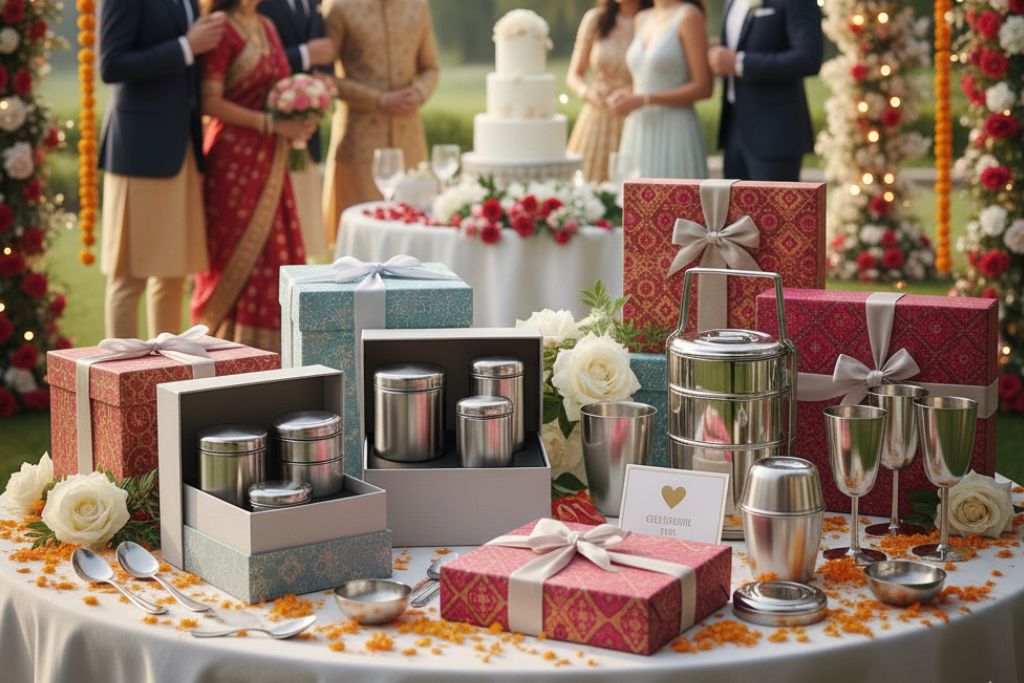
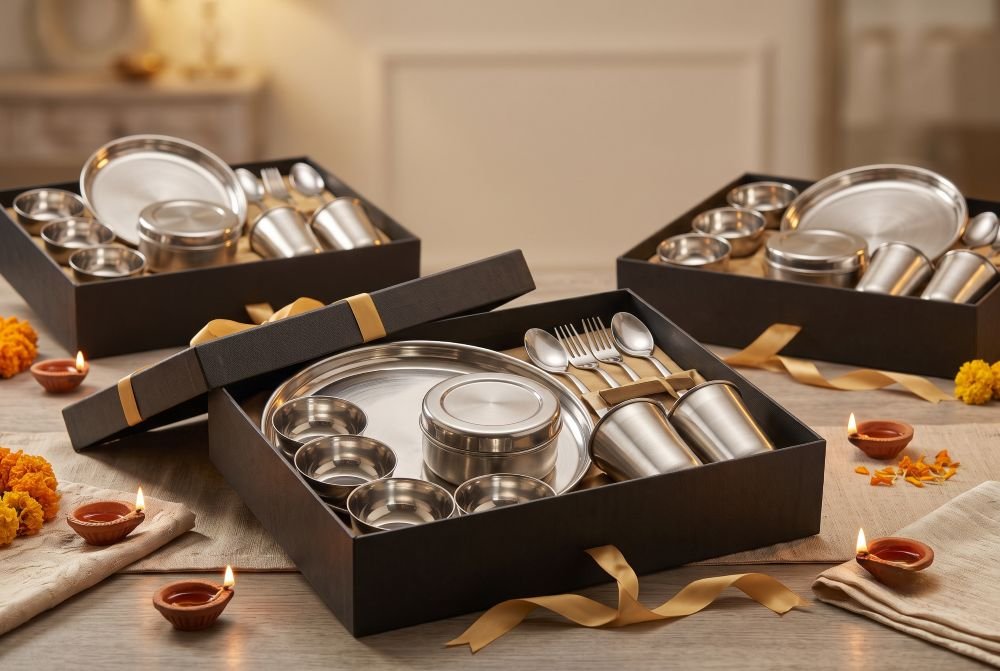
Every festive season, HR and procurement teams sit across a familiar dilemma. The gifting budget has been approved, the employee count or client list is finalised, and someone now has to pick an item that will not be sitting untouched in a drawer by December. Diaries, pen sets and desk clocks are safe choices precisely because nobody remembers them a year later, and that is exactly the problem a company is trying to avoid when it spends money on gifting in the first place.
This is one reason utensils and tableware have quietly become one of the more dependable categories in Indian corporate gifting, particularly around Diwali, when nearly every organisation with more than a handful of employees is placing some kind of bulk order. Among the material choices on offer, one keeps coming up in procurement conversations for reasons that go well beyond tradition or festive sentiment.
This article looks at why steel utensil sets hold up so well as a gifting category, which product formats companies are actually choosing right now, how to match a set to the occasion and the recipient, and what the ordering process looks like once a company decides to move ahead with bulk stainless utensils for corporate gifting.
Why Steel Utensil Sets Work as Corporate Gifts
Corporate gifting has two audiences to satisfy at once. The person handing out the budget wants a gift that reflects well on the organisation, and the person receiving it wants something they will actually use. Steel tableware and kitchenware manage to satisfy both because the category sits at the intersection of everyday utility and a certain quiet dependability that Indian households already associate with the material.
Unlike gifts built around a trend or a seasonal design, steel utensils do not go out of fashion in a kitchen. A set bought this Diwali is still doing its job at the next one, which changes the economics of gifting from a one-time impression to a recurring, low-cost reminder of the company each time it is used.
Everyday Utility Beats Novelty Items
A desk gadget or a decorative showpiece earns a moment of appreciation and then a permanent spot on a shelf. A dabba that goes into a lunch bag every morning, or a thali that comes out for every meal, gets handled far more often and for far longer. That repeated, ordinary contact is what corporate gifting is actually trying to buy, even if the brief rarely spells it out that plainly.
Procurement teams that have run gifting programmes for a few years tend to notice this pattern themselves. Feedback on decorative gifts fades quickly, while feedback on kitchen and dining items keeps surfacing long after the festival, usually in the form of an employee mentioning they are still using the set at home.
Food Safe and Durable Across a Range of Climates
India’s food habits are hard on cookware and tableware. Tamarind-based gravies, pickles, and other acidic preparations common in coastal and southern kitchens will corrode or discolour weaker metals over time, and humidity in coastal cities adds another layer of stress on anything gifted for daily use. Stainless steel handles both reasonably well, which is part of why it has remained the default material for tableware across Indian homes for decades rather than being replaced by newer alternatives.
This durability also protects the gifting budget in a way that is easy to overlook. A cheaper material that discolours or develops a rough edge within a year reflects poorly on the company that gave it, while a steel set that still looks presentable years later keeps doing quiet, low-effort brand work well past the point most gifts would have been thrown away.
Suitable for Every Recipient Regardless of Role
Apparel needs sizing, grooming kits assume gendered preferences, and electronics age out of relevance within a couple of product cycles. Steel tableware sidesteps all three problems. A set that suits a factory floor supervisor works just as well for a senior manager, and the same product line can be used across an entire workforce without needing multiple variants.
This uniformity matters more in large-scale gifting than it first appears. A company distributing gifts to several hundred or several thousand employees needs a category that does not require a decision tree of sizes, colours, or role-based variants, and steel tableware is one of the few categories that genuinely works this way at scale.
Popular Stainless Steel Formats for Bulk Corporate Orders
Not every steel product suits every occasion, and companies ordering in bulk usually end up choosing from a fairly consistent set of formats once they have compared a few options. Each format tends to map to a slightly different budget and gifting purpose, from an everyday utility item to a more premium festive hamper piece.
Understanding what each format is typically used for makes it easier for a procurement team to match the product to the occasion rather than defaulting to whatever a vendor pushes hardest.
Thali and Tray Sets for Festive Hampers
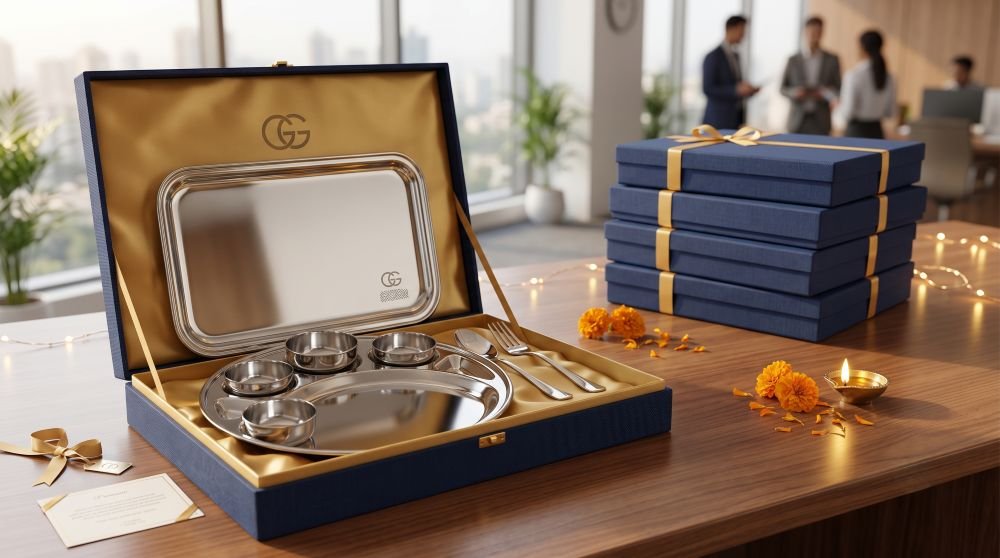
A stainless steel thali/tray set is one of the more traditional choices for a festive hamper, and it tends to be read as a slightly more formal or ceremonial gift than an everyday kitchen item. It suits Diwali and other festival occasions particularly well because a thali already carries cultural association with celebration and shared meals, which fits the sentiment companies are usually trying to convey during the festive season.
Because thali sets are often gifted rather than used for daily cooking in the same way a dabba is, they also lend themselves better to engraving or packaging upgrades. A company that wants a single premium hero item in a larger hamper, alongside sweets or dry fruits, often anchors that hamper around a thali or tray set.
Dabbas and Canisters for Everyday Storage
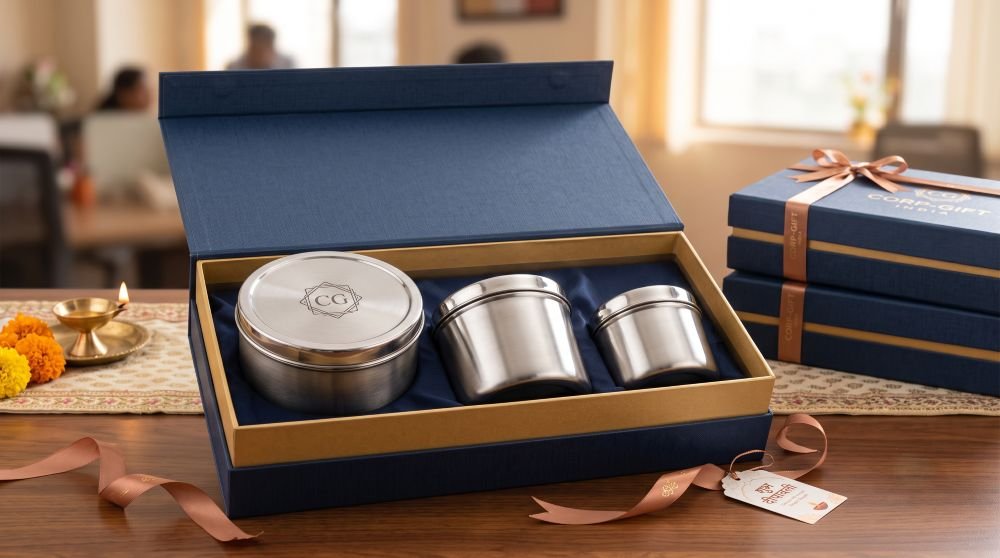
A stainless steel dabba/canister set sits at the more practical end of the spectrum. These are used for storing spices, dry snacks, tea, or lunch, and they get handled multiple times a day in most Indian kitchens, which makes them one of the highest-utility choices available in this category.
Dabba sets also scale down comfortably into smaller, lower-cost tiers without losing their usefulness, which makes them a common choice for companies running a large employee welcome kit or festive gifting programme on a tighter per-person budget.
Spoons and Serving Sets
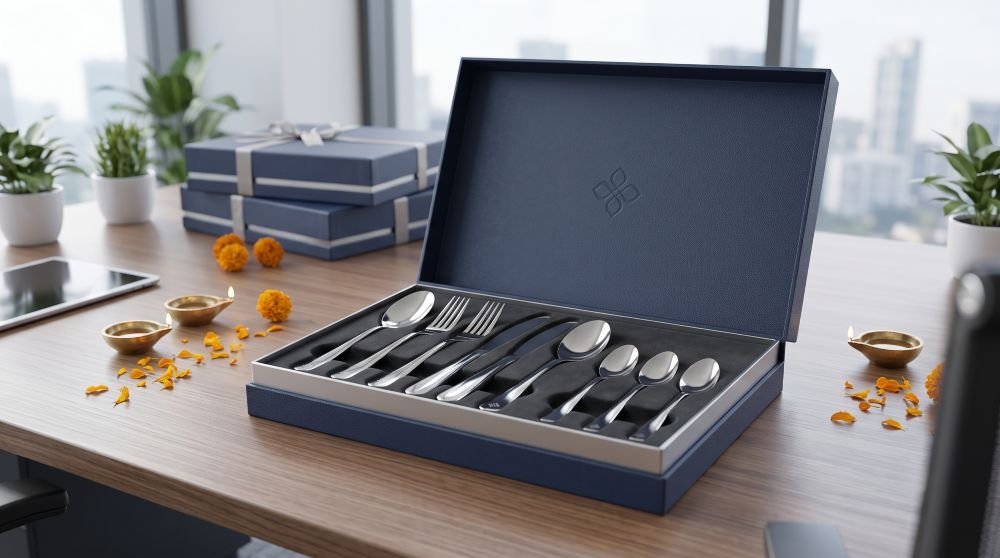
A stainless steel spoon set, whether it is a plain cutlery set or a serving spoon collection, is one of the simplest and most cost-effective bulk gifting options available. It is easy to package attractively, easy to brand through the box rather than the product itself, and rarely triggers concerns about quality the way a more complex item might.
Because spoon sets are relatively inexpensive per unit compared to thalis or larger canister sets, they are frequently used as an add-on item within a larger hamper rather than as the sole gift, which helps a company stretch a festive gifting budget across a bigger hamper without cutting into the quality of the anchor item.
Glasses, Cups and Newer Formats Like the Fruit Basket
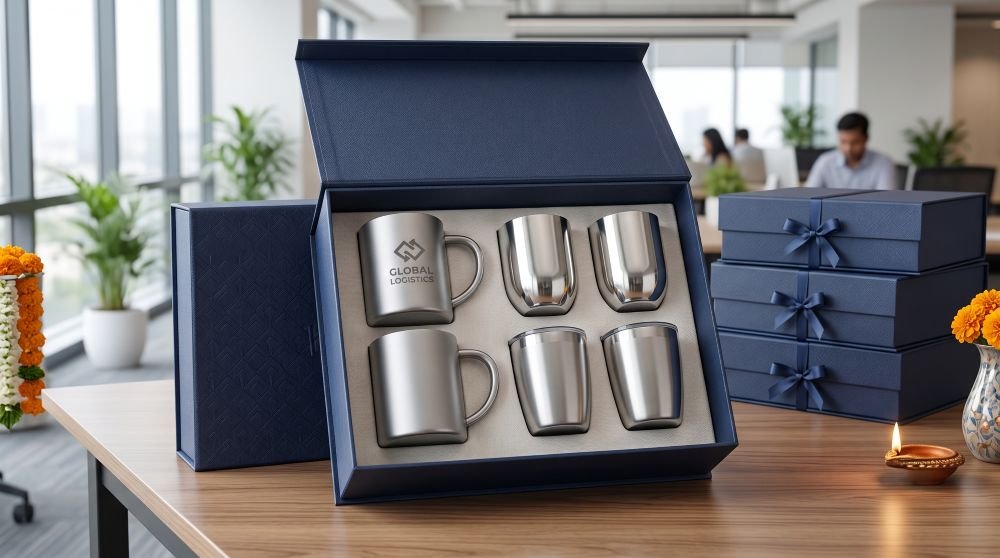
Beyond the traditional categories, stainless steel glasses and stainless steel cups have become common inclusions in mixed hampers, mainly because they are inexpensive, genuinely used at home, and easy to brand on the base or the packaging without affecting how the product is used.
A more recent addition to corporate hampers is the viral stainless steel fruit basket, which has picked up popularity through social media in the last couple of festive seasons. Its appeal for corporate gifting comes from the fact that it doubles as a decorative piece as well as a functional one, giving a hamper a slightly more premium visual anchor without the higher unit cost of a full dinner set.
Matching the Gift Set to the Corporate Occasion
The right steel product depends heavily on who is receiving it and why. A gift meant to make an employee feel appreciated after a long year reads differently from a gift meant to keep a long-standing client relationship warm, and companies that plan these separately tend to get noticeably better feedback than those that send an identical hamper to every recipient regardless of relationship.
Most organisations in India end up planning at least two, and often three, separate gifting tracks each festive season: one for the internal workforce, one for external clients and partners, and a broader logistics plan for whichever track involves the larger numbers.
Diwali Gifts for Employees
When putting together diwali corporate gifts for employees, the emphasis usually shifts towards practicality and a sense of being looked after rather than pure prestige. Dabba sets, cutlery sets, and mid-tier tableware combinations tend to perform well here because employees are receiving them in large numbers and comparing notes with colleagues, which makes consistency and genuine usefulness more important than a single standout item.
Companies distributing gifts across a large and varied workforce, including factory staff, field teams, and office employees, also tend to prefer formats that travel well and do not require special handling, which rules out anything fragile or oversized regardless of how attractive it looks in a catalogue.
Diwali Gifts for Clients and Business Partners
For diwali corporate gifts for clients, the calculation shifts. Client gifting is usually done in smaller volumes but with a higher per-unit budget, since the goal is to signal the value of the relationship rather than distribute a uniform token to everyone. This is where thali and tray sets, or a curated hamper anchored around a fruit basket or a premium finish product, tend to outperform simpler everyday items.
Packaging matters more in this track as well. A client gift is often opened in front of the giver or shared with a client’s own family, so the unboxing experience and the visual presentation of the set carry more weight than they would in an employee gifting programme distributed in bulk.
Planning Gifts Across a Large Workforce
Companies planning bulk diwali corporate gifts across several hundred or several thousand recipients usually run into logistics questions well before they run into product questions. Storage space for the incoming stock, distribution across multiple office locations or factory sites, and a realistic internal timeline for packing and handing out gifts before the festival itself all need to be worked out ahead of placing the order, not after.
Because steel utensil sets are compact, stack well, and do not require special climate control or fragile-item handling, they tend to be considerably easier to store and move across locations in bulk compared to categories like electronics or perishable hampers, which is a practical advantage that only becomes obvious once a company has actually tried to coordinate a large-scale distribution.
What Separates a Premium Steel Set From a Generic One
Not all steel tableware is made to the same standard, and the difference is not always visible on a showroom shelf. Gauge, or the thickness of the steel used, has a direct effect on how a piece feels in the hand and how well it resists denting over years of use, and lighter gauge products are often priced closer to premium ones despite a noticeably shorter working life.
Anyone researching diwali corporate gift ideas during the festive rush will also find that not every steel product on sale carries formal quality backing. A recognised certification mark is one of the few objective ways for a procurement team to verify that a batch of utensils meets a defined composition and safety standard, rather than relying on a supplier’s own claims about quality, which is a useful check to run before committing to a large order.
How to Place a Bulk Order
The ordering process for bulk steel gifting tends to follow a fairly predictable sequence once a company has decided on a rough budget and product category. Understanding this sequence in advance helps a procurement team avoid the most common cause of festive gifting delays, which is starting the process too close to the festival date.
Requesting Quotes and Deciding on Minimum Order Quantities
Most manufacturers work on a minimum order quantity that varies by product and by whether the buyer wants any customisation applied. A plain, unbranded order of a standard product can usually be placed at a lower minimum than an order requiring engraving, printed boxes, or a mix of multiple products bundled into one hamper, since customisation adds a setup step that is not worth running for a very small batch.
A realistic quote request should include the total quantity needed, the intended per-unit or per-hamper budget, and whether the order needs to be split across delivery locations, since all three of these directly affect both pricing and the production timeline a manufacturer can commit to.
Customisation Through Branding and Packaging
Bulk corporate orders are rarely sold as plain, unbranded product. Most companies want their logo, a short message, or an employee’s name applied either directly on the item or on the box it ships in, and the method used depends on the product and the budget available for that step.
Engraving tends to suit metal surfaces like a thali rim, a spoon handle, or the base of a cup, and holds up well over years of use since it becomes part of the metal rather than sitting on top of it. Printed or embossed packaging is a cheaper and faster alternative when the budget does not stretch to engraving every unit, and it still delivers a branded unboxing moment even if the product itself stays plain.
Sampling and Lead Times Before the Festive Deadline
A sample approval step before full production is worth insisting on for any order above a modest quantity, since it is the only reliable way to confirm gauge, finish, and branding placement before hundreds or thousands of units are committed to a single design. Skipping this step to save a few days is one of the more common regrets procurement teams report after a rushed festive order.
Lead times for customised bulk orders typically run into several weeks once production, quality checks, and packaging are all accounted for, which means a company aiming for a Diwali delivery is generally better off finalising its product choice and placing the order well before the festive rush begins, rather than treating the timeline as flexible right up to the last month.
Conclusion
Stainless steel utensil sets have earned their place in Indian corporate gifting programmes not through marketing but through repeated, ordinary use. A dabba that goes into a lunch bag, a thali that comes out at every meal, or a set of cups sitting on a kitchen shelf keeps a company’s gesture visible for years rather than for the single afternoon a gift is unwrapped.
The category also solves practical problems that other gifting choices struggle with. It does not require sizing decisions, it tolerates the acidic and humid conditions common across Indian kitchens, and it scales cleanly across a workforce of any size without needing multiple product variants.
Getting the details right, matching the format to the occasion, checking gauge and certification rather than relying on appearance alone, and building enough lead time into the order, is what turns a routine bulk purchase into a gift that recipients genuinely keep and use long after the festival season has passed.