
Every October, sales leaders and relationship managers across Indian companies work through a shorter but higher-stakes list than the one HR is managing for employees: which clients to gift, what to send them, and how to make sure the gesture reflects well on the business relationship rather than reading as an afterthought.
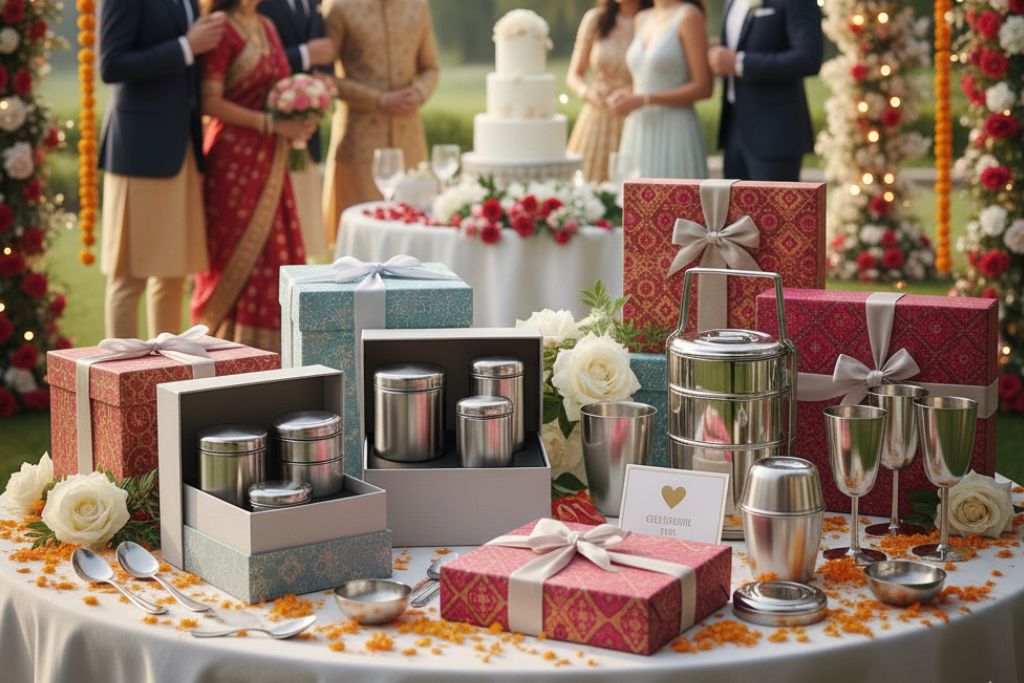
Client gifting operates under a different set of pressures than employee gifting. Where an employee gifting programme distributes a uniform box to hundreds or thousands of people at once, client gifts are usually sent in smaller numbers, individually or in curated batches, and adjusted based on the size and stage of each relationship. This is where thoughtful corporate Diwali gift ideas, including premium stainless steel corporate gifts, can offer a practical way to recognise important business relationships.
This article looks at how client gifting differs from employee gifting, what makes a Diwali gift appropriate for a business relationship, and the premium categories and practical considerations that tend to matter most when choosing corporate Diwali gifts for clients rather than colleagues.
How Client Gifting Differs from Employee Gifting
Client organisations frequently maintain their own internal gifting policies, and some restrict the value of gifts their employees can accept from vendors or partners to avoid any appearance of influencing procurement decisions. A sender needs to be mindful of the thresholds a recipient’s company may enforce internally, even where the sending company sets no formal limit of its own.
The number of recipients involved also changes how much individual attention each gift can reasonably receive. A company gifting four hundred employees typically cannot review each recipient’s preferences individually, but a company gifting forty key clients usually can, and skipping that individual attention at the client tier is often more noticeable to the recipient than it would be at the employee tier, precisely because the smaller number makes uniform treatment more visible.
While employee gifting can rely on uniform bulk boxes distributed across an entire workforce, client gifting typically involves fewer total recipients but considerably more scrutiny per gift, since each box represents the business relationship and is often opened in a shared office setting rather than privately at home.
What Makes a Diwali Gift Appropriate for Business Clients
Professional Presentation and Packaging
Packaging quality tends to carry more weight in client gifting than in employee gifting, since the first visual impression on unboxing reflects directly on the sending company’s brand. Corporate branded boxes with restrained design generally read as more professional than heavily festive or religious imagery on the outer packaging, even when the contents inside are traditional.
Understated presentation choices, a printed card carrying a business message rather than a personal note, and muted colour palettes over bright festival packaging, keep the gift appropriate for a professional-to-professional relationship rather than a personal one.
Avoiding Overly Personal or Religious Items
Because a client organisation likely includes employees across multiple faiths and the gift represents a business relationship rather than a personal one, items tied closely to specific religious rituals are generally better suited to internal employee gifting than to external client gifting.
Neutral festive items, connected broadly to themes of light, renewal and gratitude rather than to a specific religious practice, tend to be received well across a diverse client base without requiring the sender to make assumptions about the recipient’s personal beliefs.
Aligning Gift Value With Company Gifting Policies
Many organisations, particularly larger corporates and public sector entities, cap the value of gifts their employees are permitted to accept from external vendors and partners as part of internal compliance policy. Senders who are unsure of a specific client’s threshold often default to a moderate, clearly non-transactional gift value rather than an extravagant one that could put the recipient in an awkward position.
Maintaining a record of what was sent to which client, particularly for larger accounts, also supports the sending company’s own internal compliance and finance documentation for the gifting programme.
Premium Gift Categories for Clients
Gourmet and Curated Hampers

Premium hampers combining dry fruits, chocolates and gourmet snacks remain a common default for client gifting because they are almost universally acceptable and require no explanation to any recipient, regardless of their personal or professional background.
At the premium end, curation and packaging quality differentiate the gift far more than sheer quantity does. A smaller, carefully curated hamper generally reads better to a business client than a larger but generically assembled one.
Premium Kitchenware and Tableware Sets

For client relationships that extend across multiple years, a premium stainless steel tableware set in a higher grade finish, such as Grade 304 with a mirror or matte finish, offers a longer-lasting impression than a hamper that is consumed within the festival week itself.
Kitchenware gifts work particularly well for clients in hospitality, food service or institutional catering, sectors where the gift also carries direct professional relevance to the recipient’s own business rather than being purely a personal item.
Personalised or Branded Corporate Merchandise

Subtly branded items, engraved with the client company’s own name rather than the sender’s logo, are sometimes used for very senior or long-standing relationships to signal a personal touch rather than a mass-produced gesture.
This level of customisation carries a longer lead time than a standard branded gift, so it needs to be planned further ahead of the festive deadline to allow for engraving and any design approval involved.
Client Gift Ideas by Industry and Relationship Type
Beyond the general premium categories covered above, the specific type of client relationship often points toward a more fitting gift than a generic default, since a vendor relationship, a channel partnership and a long-term strategic account each carry a different tone.
Vendors, Suppliers and Channel Partners
Gifts to vendors and channel partners generally sit at a more modest value tier than gifts to revenue-generating clients, since the relationship dynamic runs in the opposite direction and an overly generous gift in this direction can read as an attempt to influence future commercial terms rather than as a simple courtesy.
A practical, moderately priced item such as a compact kitchenware piece or a smaller curated hamper tends to strike the right tone here, acknowledging the relationship without introducing the compliance concerns that a higher value gift might raise on the receiving end.
Strategic and Long-Term Accounts
For a small number of accounts that represent a disproportionate share of revenue or strategic value, many companies allocate a meaningfully higher gifting budget than the standard client tier, recognising that the relationship itself justifies additional investment beyond what a uniform client gifting policy would otherwise allow.
These gifts are typically the ones most likely to involve individual customisation, such as engraving the client company’s name, and are usually hand-delivered or couriered with additional care rather than batched together with the wider client gifting run, given the smaller number of recipients involved.
Practical Considerations When Selecting Client Gifts
Selecting the right category and presentation for a client gift is only half the task. The considerations below, matching value to relationship stage, managing delivery logistics under festive-season pressure, and keeping the sending company’s own records in order, determine whether a well-chosen gift actually lands the way it was intended to.
Matching Gifts to Client Seniority and Relationship Stage
A newly acquired client account and a decade-long strategic partner rarely warrant identical gifts. Tiering client gifts by relationship value, in the same way many sales teams already tier client servicing effort, keeps the gesture proportionate to the relationship rather than uniform across accounts of very different depth.
For very large or long-standing accounts, a personal note referencing the specific working relationship, alongside the gift itself, often matters more to the recipient than the monetary value of the item.
Logistics: Courier Timing Before Diwali Rush
Courier and logistics networks across India see significant volume surges in the weeks before Diwali, so client gifts intended to arrive before the festival need to be dispatched with a meaningful buffer, particularly for clients located outside major metro areas.
Tracking delivery confirmation for client-facing gifts matters considerably more than it does for internal employee distribution, since a delayed or lost client gift reflects on the sending company in a way an internal shipping mishap typically does not.
Documentation for Tax and Compliance Purposes
Businesses in India generally maintain records of client gifting for their own accounting and compliance purposes, since gift-related expenditure can carry tax treatment implications depending on the nature and value involved. Finance teams typically ask for vendor invoices and a distribution list alongside the gifting programme itself.
Coordinating early between the team choosing the gifts and the finance team responsible for documentation avoids paperwork gaps that otherwise surface only once the gifting cycle is already underway.
Conclusion
Client gifting sits at the intersection of relationship management and brand representation, which sets it apart from employee gifting even when both programmes run during the same festive season.
Premium, professionally presented and policy-aware gifts, whether curated hampers or kitchenware, tend to serve that purpose well without overstepping into territory that could be read as excessive or as an attempt to unduly influence the relationship.
The right specific choice ultimately depends on the nature of each client relationship, but the underlying principles of restraint in presentation, awareness of the recipient’s own compliance environment, and attention to logistics timing hold across nearly every business context.
Companies that treat client gifting as a distinct exercise from employee gifting, rather than a scaled-down version of the same programme, tend to avoid both the presentation missteps and the compliance concerns that a one-size-fits-all approach to festive gifting can create.