Scrolling through stainless steel dinner set listings online turns up dozens of options within minutes, each promising a different piece count, finish and gauge, with very little consistent guidance on what actually separates a set that lasts a decade from one that starts denting and discolouring within a year.
Unlike many kitchen purchases made once every few years and then forgotten, a dinner set sees daily use in most Indian households, often multiple times a day across an entire family. Getting the underlying material choices right therefore matters considerably more than the number of pieces listed in a bundle.
This guide walks through the grade, gauge, finish and design factors that determine whether a stainless steel dinner set holds up to years of daily Indian cooking and dining, along with practical checks to make before buying.
Understanding Stainless Steel Grades Before You Buy
Grade 202 vs Grade 304: What the Difference Means at Home
The difference between commonly used steel grades comes down primarily to nickel content, which affects corrosion resistance and how the steel responds to prolonged contact with acidic food. A detailed look at the stainless steel grades used in Indian kitchenware breaks down the composition differences in full, but the practical takeaway for a household buyer is straightforward.
Grade 304 handles regular exposure to acidic Indian cooking, tamarind-based gravies, lemon rice, pickles and similar preparations, with less risk of discolouration building up over years compared to Grade 202, though it costs more. Grade 202 remains widely used and performs perfectly well for everyday flatware and pieces that see shorter, less consistent contact with acidic liquids.
Many households choose Grade 304 for bowls and katoris that regularly hold gravies for extended periods, and Grade 202 for plates and serving pieces exposed less consistently, though a full Grade 304 set is the safer long-term choice where budget allows.
Reading 18/8 and 18/10 Markings on Packaging
Markings such as 18/8 and 18/10 refer to the chromium and nickel content of the steel and correlate closely with the Grade 304 family of stainless steel. Understanding what 18/8 and 18/10 stamped on steel utensils actually mean allows a buyer to cross-check grade claims printed on packaging against what a product listing describes.
The absence of any such marking on a listing is itself useful information. Established manufacturers of genuine 304 or comparable grade steel typically state the composition clearly, so a listing that only describes the product vaguely as premium steel without a corresponding marking warrants more caution before purchase.
Gauge and Thickness: Why It Matters More Than Piece Count
Gauge, meaning the thickness of the steel, affects both durability and how a plate or bowl feels in daily handling. Thinner gauge steel dents more easily with routine use and can warp slightly under sustained heat, while heavier gauge pieces hold their shape and resist denting through years of daily washing and stacking.
Many marketplace listings emphasise piece count as the headline feature, advertising a set as containing forty or fifty pieces. A lighter gauge set with a high piece count often wears out faster in practice than a smaller set made from heavier gauge steel, so checking the gauge specification, where it is listed, alongside the piece count gives a more accurate read on long-term value than piece count alone.
Buyers shopping in person can get a reasonable sense of gauge simply by picking up two plates of similar size and comparing weight and rigidity, since a heavier, stiffer plate for the same dimensions usually indicates a thicker gauge. Online buyers do not have this option, which is why checking the specification sheet or asking the seller directly for the gauge number, rather than relying on marketing terms such as heavy duty alone, is worth the extra step before ordering a full set.
Finish and Design Considerations
Mirror Finish vs Matte Finish
Mirror finish, the reflective glossy surface common in gift-oriented and premium sets, shows fingerprints and fine scratches more visibly over time compared to a matte or satin finish, which tends to hide the marks of daily wear considerably better in a household that uses the set constantly.
Mirror finish sets do photograph and present better for guests and special occasions, which is why some households keep a smaller mirror finish set reserved for guests separately from a larger matte finish set used for everyday meals, rather than relying on a single large set for both purposes.
Also read our article on Mirror Finish vs Matte Finish in Stainless Steel Utensils
Plate Depth, Rim Design and Stackability
Deeper rimmed plates hold gravies and curries without spilling over the edge during a meal, a genuinely practical consideration for typical Indian meals that often include several wet dishes served together on one plate, unlike shallower Western-style dinner plates designed around a single course at a time.
Stackability, meaning how neatly plates and bowls nest together for storage, matters considerably more in smaller Indian kitchens with limited cabinet space than it might in larger kitchens elsewhere. Checking the stated stacking dimensions against available storage space avoids ending up with a set that looks appealing in product photos but does not actually fit existing shelving.
What a Complete Dinner Set Should Include
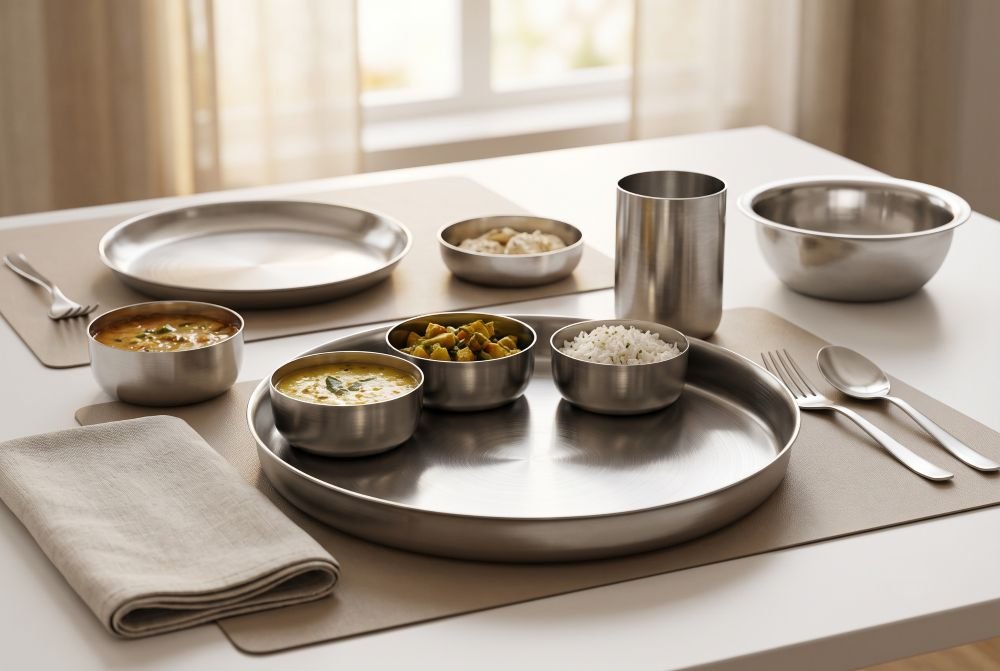
A typical Indian dinner set built around stainless steel dinner sets and tableware includes full plates, quarter or side plates, several katoris for curries and dal, glasses or tumblers, and often one or two serving bowls, sometimes bundled together with a base thali. Sets built around stainless steel thali sets specifically emphasise the thali as the central serving piece rather than a standard flat plate.
Households cooking primarily Indian meals generally benefit from prioritising katori count over Western-style components such as separate dessert plates, since most daily meals rely far more heavily on several small bowls served alongside the main plate than on distinct courses.
Larger sets aimed at joint families or households that host guests regularly sometimes include additional serving pieces such as a ladle, a larger serving bowl with a lid, or extra tumblers beyond the core per-person count, which is worth checking for specifically if the household regularly serves more people than the number of core place settings included in a listed set.
Practical Buying Tips for Indian Kitchens
Matching the Set to Family Size and Daily Use
A set sized to the exact daily headcount leaves no buffer for guests, while a set sized generously for occasional entertaining sits mostly unused in storage for the rest of the year. Most households benefit from a core daily set sized to the family, supplemented by a smaller number of additional pieces reserved specifically for guest occasions, rather than one oversized set used inconsistently.
Joint families and households that host frequently for religious or social occasions generally benefit from a larger base set than a two or three person household, where a compact set reduces both storage pressure and overall cost without leaving pieces unused.
Checking for BIS Compliance and Food-Grade Certification
Stainless steel utensils sold in India fall under quality requirements set by national standards bodies, and understanding BIS certification for stainless steel utensils gives buyers a baseline check against which to evaluate a product’s claimed composition. Checking for compliance markings or a manufacturer’s stated adherence to the relevant standard provides a degree of assurance that the actual steel composition matches what is advertised.
This check matters most when purchasing outside established retail channels, such as local markets or unbranded online listings, where the gap between a claimed grade and the actual composition used tends to be wider than with established, traceable manufacturers.
Balancing Budget With Long-Term Durability
A heavier gauge, higher grade set costs more at the point of purchase but typically outlasts a cheaper, lighter set by several years, so the effective annual cost of ownership often favours the more expensive set once its longer usable life is factored into the comparison.
For buyers working with a tighter budget, prioritising grade and gauge on the pieces used most frequently, plates and katoris used daily, while economising on less frequently used serving pieces, is a reasonable way to balance upfront cost against long-term durability rather than compromising uniformly across the entire set.
Conclusion
Grade, gauge and finish matter considerably more to long-term satisfaction with a stainless steel dinner set than piece count or headline price, even though piece count and price are usually what listings emphasise most prominently.
Buyers who check these underlying specifications before comparing prices across options tend to end up with a set that serves their kitchen reliably for a decade or more, rather than one that needs replacing within a few years of daily use.
A well-chosen dinner set is, in practice, one of the more quietly durable purchases a household makes, and the small amount of extra attention paid to grade and gauge at the time of purchase pays off steadily over years of everyday meals.