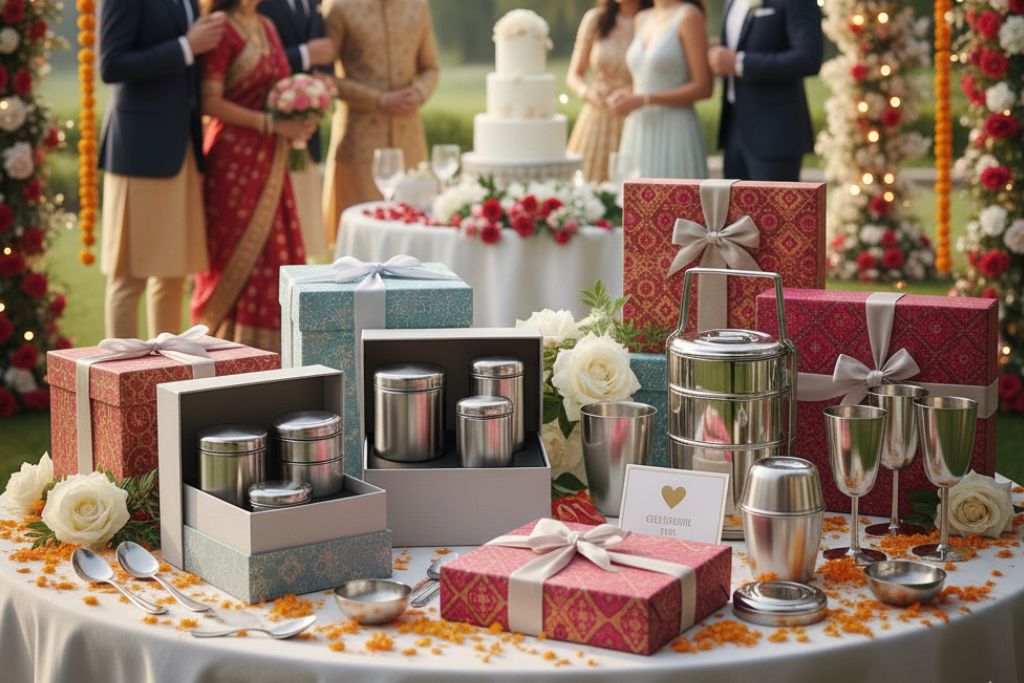
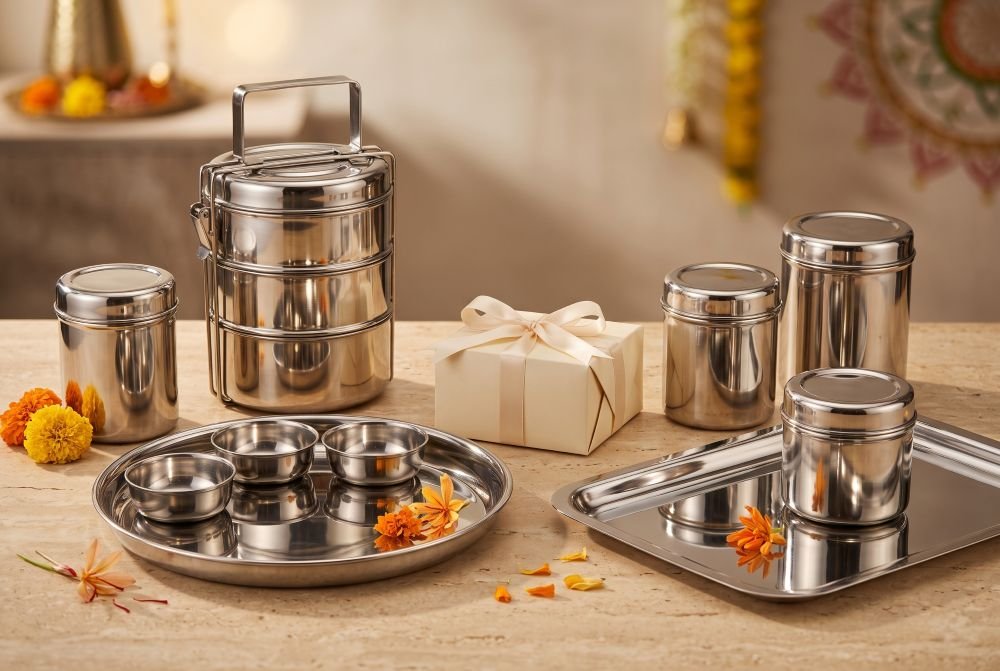
In many Indian workplaces, the nine nights of Navratri change the rhythm of the working week. Garba evenings are planned after office hours, colleagues arrive in the colour of the day, canteens add fasting menus, and the tenth day, Dussehra, brings a pause before the larger Diwali preparations begin. For HR heads and sales teams, this short window raises a practical question: is it worth marking at all, and if so, what is appropriate to give?
The answer is usually yes, provided the gift is modest in tone and useful in practice. Navratri and Dussehra sit just ahead of Diwali, so a thoughtful gesture now does not compete with the heavy gifting calendar that follows. Many businesses use this window to thank teams and to keep in touch with clients, and a durable item from a range of stainless steel corporate gifts tends to suit the occasion better than a perishable hamper that must be consumed within days.
This guide covers how to choose gifts that respect fasting customs and regional differences, which ideas work for employees and which suit clients, the stainless steel product categories worth considering, and how to handle timing, budgets and logistics so that gifts arrive when they still mean something.
Stainless Steel Gift Ideas for Navratri and Dussehra
Stainless steel suits festival gifting for practical reasons. It is durable, easy to clean, familiar to every Indian household and neutral in appearance, so it does not clash with the dietary or religious preferences of the recipient. The categories below cover the items most often considered for corporate gifting at this time of year.
The choice of category should follow the recipient. Employees generally appreciate items they will use daily, while clients and partners respond to sets and pieces that look good on a dining table or in a pantry. Within each category, sizes, finishes and gauge can be matched to the budget.
Stainless Steel Dabbas and Canisters
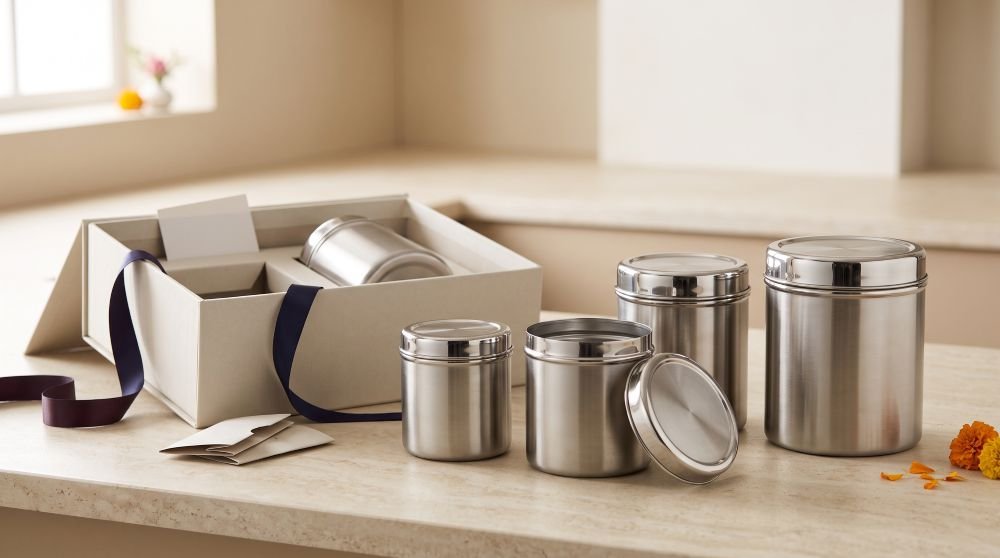
A set of stainless steel dabbas and canisters in graduated sizes is useful in nearly every Indian kitchen, and the sizes can be chosen to hold atta, dry fruits, tea or snacks.
Lids matter as much as size. A snug, easy-to-open lid keeps contents fresh and survives daily use, and plain finishes look appropriate for any recipient. Sets of three or four sizes make a gift that feels complete without being large.
Stainless Steel Tiffin Boxes
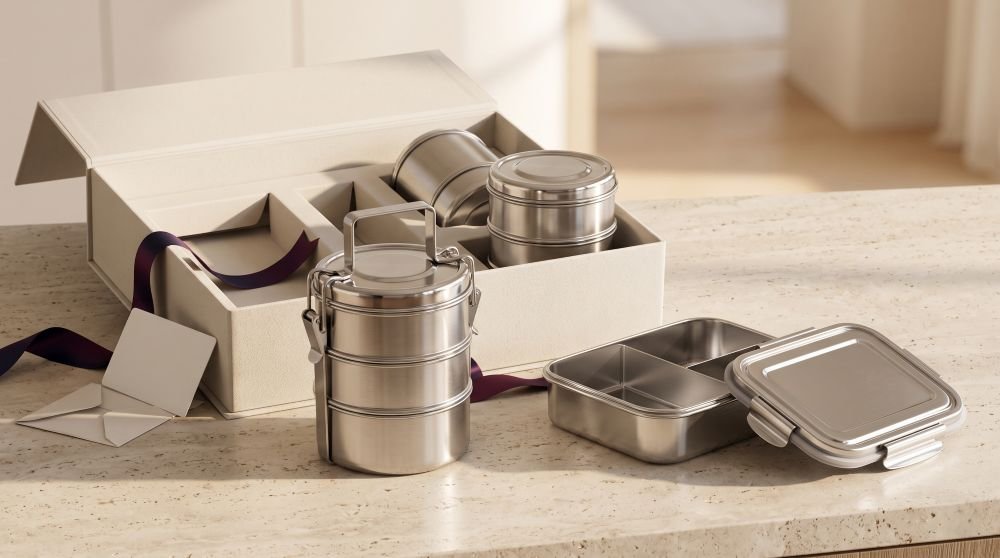
Stainless Steel Tiffins suit employees who carry lunch to the office, and a multi-tier design lets a recipient pack roti, sabzi, dal and rice separately. They also work well for carrying fasting meals during Navratri.
For recipients who fast during Navratri, a tiffin also makes it easy to carry vrat meals without relying on disposable containers. A plain design with a secure clip or lock avoids spills, which is the main practical complaint about lunch carriers.
Stainless Steel Thali Sets
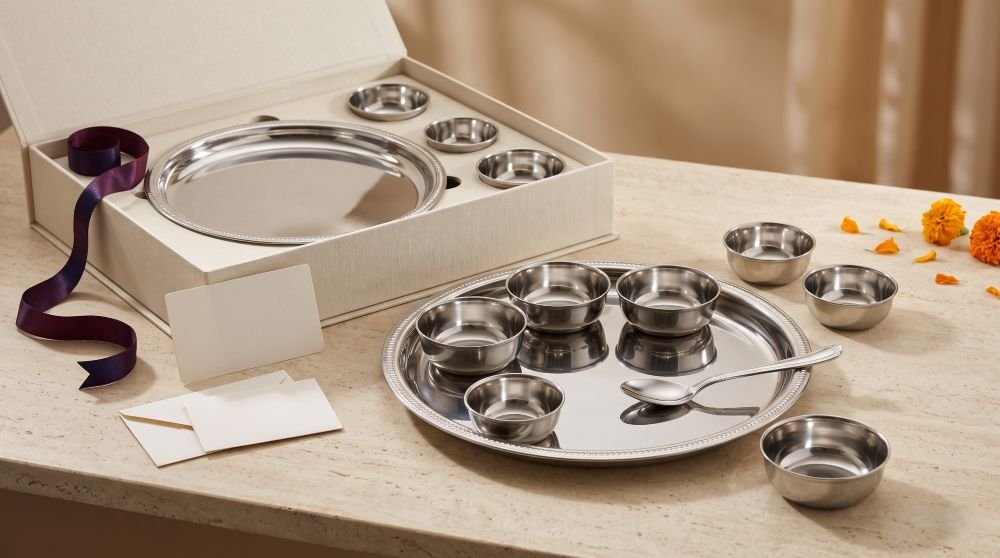
A stainless steel thali set with katoris and a matching spoon is a traditional and presentable gift, and it appeals to clients who value an Indian dining aesthetic. A set of this kind also doubles as a festive serving piece when guests visit.
Katoris in two sizes, a plate with a raised rim and a spoon make a set that works for everyday meals and festive occasions alike. Engraving can be kept to a small mark on the underside so that the set remains neutral in appearance.
Trays and Serving Platters
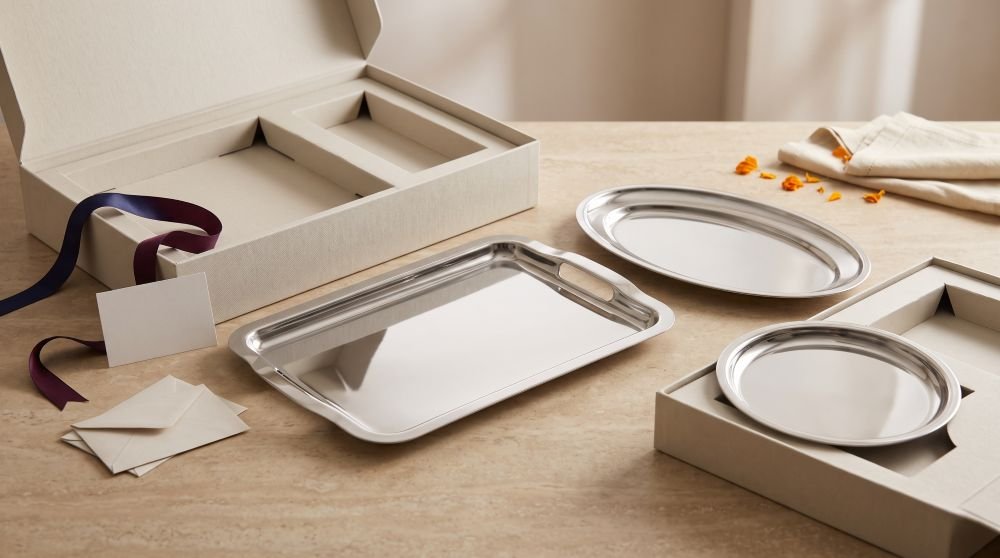
Serving trays are useful for offering prasad, sweets or dry fruits during festival visits. They are easy to clean and rarely go out of use.
Trays in plain steel suit any home, and a pair of sizes, one for serving and one for carrying, increases their usefulness. They also pack flat, which keeps shipping costs lower for large employee lists.
Spoons and Cutlery Sets
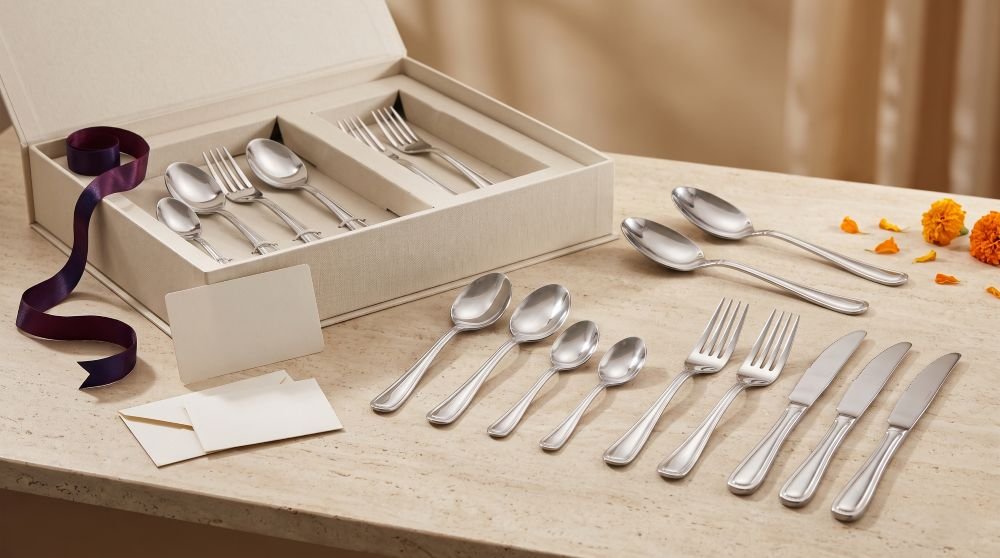
A boxed set of stainless steel spoons and cutlery is a compact gift that is easy to pack and ship, which makes it practical for large employee lists.
A boxed set of serving spoons, tea spoons or a mixed selection fits easily into a courier bag and needs little packaging beyond a neat box. It is a sensible choice for teams spread across many cities, where delivery cost matters.
Dinner Sets and Bowls
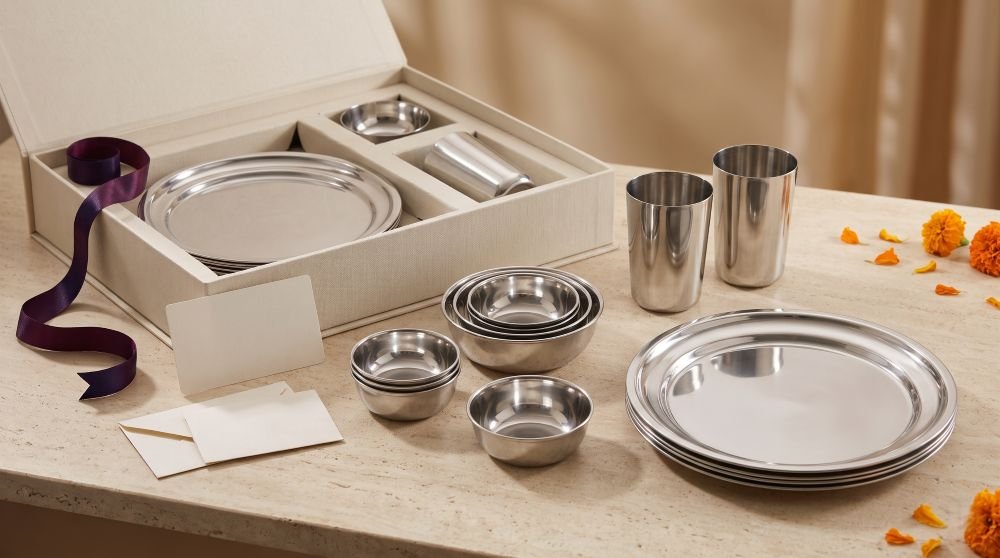
Matched dinner sets and serving bowls from a range of stainless steel tableware sets suit client and partner gifting, where presentation matters more than quantity.
A set with plates, bowls and tumblers gives the recipient something to use whenever they host family. Because such sets are heavier, they suit a smaller list of clients and partners.
Kitchen Essentials
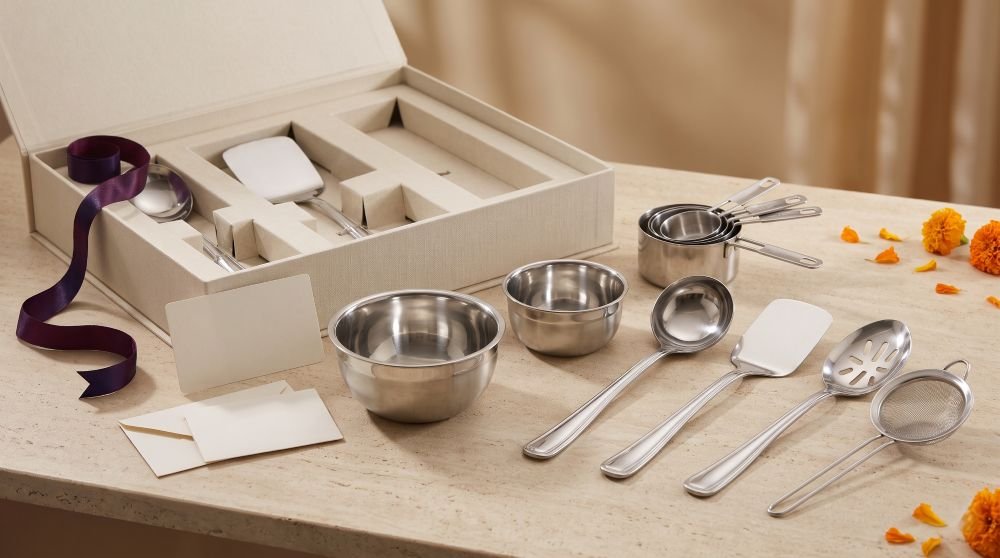
Everyday cooking and serving items from stainless steel kitchenware suit recipients who enjoy cooking, and they are often appreciated by the families of employees as much as by the employees themselves.
Because kitchen items are used daily, a gift in this category tends to stay visible in the home. Choosing items that complement the thali or dabba sets given in earlier years can build a consistent range over time.
Why Navratri and Dussehra Work as Gifting Occasions
Navratri celebrates the goddess Durga over nine nights, and Dussehra, also called Vijayadashami, marks the victory of good over evil on the tenth day. The festival carries themes that translate well into the workplace: perseverance, new beginnings and the recognition of effort. In many offices, factories and workshops, Ayudha Puja, the worship of tools and equipment, takes place around this time, which gives businesses a natural reason to acknowledge the people who work with those tools every day.
The festival is also observed differently across India. Gujarat and parts of Maharashtra celebrate with garba and dandiya, Bengal and the east focus on Durga Puja, Tamil Nadu homes arrange Golu displays, Karnataka marks Dasara with processions, and Himachal Pradesh hosts the Kullu Dussehra. A gift that avoids regional symbols and instead offers everyday usefulness will land comfortably with a team spread across several cities.
What Makes a Gift Appropriate for Navratri
Because Navratri has religious significance for many recipients, appropriateness matters more here than it does for a generic year-end gift. A few simple principles keep a corporate gift thoughtful instead of awkward, and the three that come up most often are covered in the sections below.
None of these principles requires deep knowledge of each recipient’s personal practice. They require only a willingness to choose neutral, useful and respectful items, and to avoid assumptions about who observes which custom.
Respecting Fasting and Dietary Customs
Many people observe fasts during Navratri, eating only specific foods such as sabudana, kuttu or singhara flour preparations, fruit and milk products, while avoiding grains, onion and garlic. A food hamper can therefore miss the mark badly, since a box of mixed snacks or sweets may be unsuitable for a large part of the team. Non-food gifts remove that risk entirely.
Durable kitchen and storage items sit comfortably inside this approach. A stainless steel dabba is a practical way to carry fasting meals to the office, and a set of katoris suits serving fruit, curd or sabudana khichdi at home. Neither item makes any assumption about whether the recipient fasts.
Choosing Neutral Colours and Symbols
Navratri is often associated with a colour for each of the nine days, and some offices encourage staff to dress accordingly. It is tempting to build a gift around that scheme, but published colour sequences differ between sources and regions, so a colour-coded gift can easily look inconsistent. Plain steel finishes, whether mirror or matte, avoid the problem and look appropriate on any day of the festival.
Religious imagery needs similar care. Idols and devotional motifs suit recipients you know to be devout, but they may be unwelcome to colleagues and clients of other faiths. Leather items are also worth avoiding during this period, because some people prefer not to use leather during the nine nights.
Thinking About Diverse Teams
Most modern workplaces include colleagues of several faiths and regions, and some may not celebrate Navratri at all. A gift described as a festive token or a seasonal thank you, instead of a religious offering, allows every employee to receive it with equal comfort. The covering note can wish everyone a happy festive season while still naming Navratri and Dussehra for those who observe them.
Giving the same gift to everyone in a team, or in a grade, also avoids unintended hierarchy. If differentiation is needed, it is better handled through the value of the item or the packaging than through the nature of the gift, so that no one feels the choice reflected an assumption about them.
Navratri and Dussehra Gift Ideas for Employees
Employee gifts at this time of year work well when they are small, practical and usable the very next day. A lunch dabba, a set of katoris, a serving spoon set or a compact thali is the sort of item people keep at their desks or in the home kitchen, and each use reminds the recipient of the gesture. Compared with novelty items that sit in a drawer, utility is the surest way to make a modest gift last.
For organisations with factories, workshops or large field teams, a uniform gift for all staff is easier to administer than tiered gifting. A durable item that suits both office and shop-floor employees, such as a sturdy tiffin, avoids awkward questions about who received what. It is also worth timing distribution with the Ayudha Puja or office puja, so that the gift becomes part of the celebration instead of a separate event.
Navratri and Dussehra Gift Ideas for Clients and Business Partners
Client gifts call for a slightly higher level of finish, since the item represents the company to someone outside it. A well-made thali set, a matched set of bowls and spoons, or a canister with a neat engraved logo tends to look considered without looking extravagant. Because the occasion is a festival and not a transaction, restraint in branding matters: a small logo on the base or lid is usually better than a large mark on the front.
A Navratri or Dussehra gift is also a good way to keep a relationship warm before Diwali, which tends to be crowded with gifts of every kind. A lighter gesture now, followed by a more elaborate Diwali gift for key accounts, spreads goodwill across the festive season and avoids the problem of a client’s desk filling up with competing hampers in a single week.
Timing, Budgets and Logistics
Planning should begin several weeks before the festival, since engraving, packaging and delivery to multiple cities all take time. A realistic schedule leaves room for a sample approval, a production run, quality checks and courier transit, and it allows for the delays that tend to accumulate before major festivals. Orders placed late are often forced into rushed packaging or partial deliveries, which spoils the effect of an otherwise good gift.
On budget, a Navratri or Dussehra gift is usually smaller in value than a Diwali gift, and organisations commonly set a flat per-head figure for employees with a modest step-up for clients. It helps to include packaging, personalisation and delivery in that figure from the start, because these costs can add a noticeable share to the unit price. Where gifts go to remote locations or to employees’ homes, a tracked and insured courier service is worth the extra cost.
The covering message deserves attention too. A short note that thanks the recipient, mentions the festival and avoids any hard sell is more effective than a long letter. For clients, a handwritten line from the account manager adds a personal touch, and for employees a message from a senior leader signals that the gift is a sincere thank you instead of a routine exercise.
Conclusion
Navratri and Dussehra offer a rare opportunity to thank people before the rush of Diwali, and the strongest results come from gifts that are practical, respectful and easy to receive. Avoiding food hampers, religious imagery and colour assumptions removes most of the risk, and durable household items fill the gap with something genuinely useful.
Employees generally value small, daily-use items such as dabbas, tiffins and katori sets, while clients and partners respond to well-finished sets that look considered on a table or in a pantry. Both groups appreciate restrained branding and tidy packaging, and both are better served by early planning than by last-minute substitutions.
A gift given in this window need not be elaborate. It needs to arrive on time, fit the festive mood without making assumptions about belief or custom, and remain useful long after the nine nights have ended. A stainless steel item chosen with these points in mind is likely to stay in use well beyond the festival season.