Anyone shopping for a new set of steel katoris, a serving spoon, or a dinner set has likely noticed that the same item is often available in two distinctly different looking versions, one that gleams like a mirror under kitchen lighting and one with a soft, even sheen that barely reflects light at all. The choice between these two, commonly labelled mirror finish and matte finish, affects far more than just appearance, and buyers often assume the shinier option is automatically the higher quality one without understanding what is actually different underneath.
Both finishes start from the same underlying steel and go through largely the same forming process, whether that is pressing, spinning or deep drawing. The difference is introduced only in the final finishing stage, where the surface is treated in one of two very different ways to arrive at either a highly reflective mirror surface or a non reflective, uniformly dull matte surface.
This article looks at how each finish is produced, how they compare in everyday durability and maintenance, what role finish plays in corrosion resistance and food safety, and where each one tends to be the more practical choice across Indian homes, hotels and institutional kitchens.
What is a Mirror Finish
A mirror finish, sometimes referred to in the trade as a number 8 finish, is a highly polished surface achieved by repeatedly buffing the steel with progressively finer abrasives until every visible grinding mark from earlier manufacturing steps has been smoothed away. The result is a surface so smooth and reflective that it behaves almost like an actual mirror, showing a clear reflection of anything held close to it.
This level of polish is achieved mechanically rather than chemically, using a series of buffing wheels loaded with polishing compounds of decreasing grit size. Each pass removes microscopic imperfections left by the previous stage, and by the time the final wheel is used, the surface has been smoothed to a level where light reflects almost uniformly rather than scattering, which is what produces the mirror like appearance.
What is a Matte Finish
A matte finish, sometimes described as a dull or satin finish depending on how pronounced the texture is, deliberately stops short of the mirror polishing stage, leaving the surface with a uniform, non reflective texture instead. Rather than smoothing the surface to a glass like level, matte finishing works by creating a very fine, even texture across the entire surface using abrasive brushing or bead blasting.
Because a matte surface scatters light rather than reflecting it in a single direction, it appears as a soft, consistent grey sheen under normal kitchen lighting instead of a bright shine. This is also why a matte surface tends to hide fingerprints, water spots and light surface marks far more effectively than a mirror surface, since the texture already breaks up light reflection before a smudge or scratch has a chance to stand out against it.
How Each Finish is Produced
Mirror and matte finished utensils often start on the very same production line, and the two diverge only at the final finishing stage, which is why manufacturers are able to offer both options across the same product range, from everyday stainless steel kitchen products to serving pieces, without needing entirely separate tooling.
Buffing and Polishing for Mirror Finish
Producing a mirror finish involves passing each piece through a sequence of buffing wheels, starting with a coarser compound to remove any visible marks from the forming process and progressing to increasingly fine compounds that bring the surface to a high shine. This is a labour and time intensive process compared to matte finishing, since each piece typically needs several passes and careful handling to avoid introducing new scratches during the polishing itself.
Because the quality of a mirror finish depends heavily on how thoroughly each polishing stage is completed, pieces intended for this finish usually go through more quality checks along the way, since even a single skipped pass or a worn buffing wheel will leave a visible dull patch or fine scratch line that stands out clearly against an otherwise reflective surface.
Bead Blasting and Brushing for Matte Finish
Matte finishing is generally achieved through one of two methods, either bead blasting, where fine glass or ceramic beads are propelled at the surface under pressure to create a uniform, slightly textured surface, or brushing, where an abrasive belt or wheel is drawn across the steel in one direction to create fine, closely spaced lines. Both methods are faster and less labour intensive than mirror polishing, since they do not require the same sequence of progressively finer passes.
A brushed matte finish, in particular, produces a directional texture that runs consistently across the surface, which is why brushed items show a subtle grain when viewed at an angle even though they appear uniformly matte when viewed straight on. This directional texture is also part of why brushed matte utensils are considered easier to manufacture consistently at high volume compared to mirror finishing, where any inconsistency in the polishing sequence is immediately visible.
Visual and Aesthetic Differences
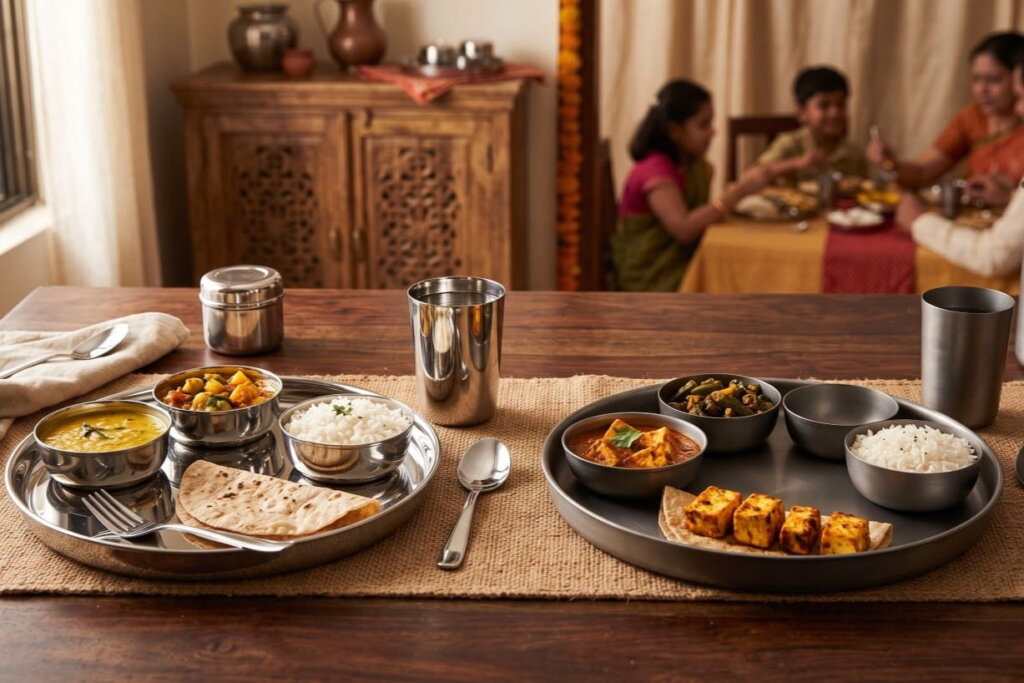
The most immediately obvious difference between the two finishes is how each interacts with light. A mirror finish reflects light in a single, concentrated direction, producing bright highlights and a clear reflection, which is why mirror finished thalis, trays and serving bowls are often chosen for festive occasions, weddings and formal dining, the same polished appeal that makes mirror finished stainless steel dinner sets and tableware popular for those settings.
A matte finish, by contrast, scatters light evenly across the surface, producing a soft, consistent appearance without sharp highlights or a visible reflection. This makes matte finished pieces suit a more understated or contemporary kitchen aesthetic, and it is part of why matte finishes have become more common in recent years on everyday cookware and storage pieces where a busy, reflective surface is less of a priority than a calm, uniform look.
Durability and Maintenance in Daily Use
Scratch and Fingerprint Visibility
A mirror finish shows every new mark against its smooth, reflective background, which means fingerprints, water spots and fine scratches from daily handling are noticeably more visible on a mirror finished thali or serving tray than on the same piece in matte finish. This does not mean mirror finished steel is more prone to scratching in an absolute sense, only that any mark that does occur stands out more clearly against a highly reflective surface.
A matte finish, because its surface is already textured rather than perfectly smooth, absorbs small marks into its existing texture rather than showing them as a stark contrast. This is one of the main reasons matte finished utensils are often recommended for households with children, for hostel messes, or for any setting where utensils are handled roughly and frequently, since the finish continues to look presentable even after months of daily use without requiring constant polishing.
Cleaning and Upkeep in Indian Kitchens
Maintaining a mirror finish over time requires more deliberate care than a matte finish, particularly in Indian kitchens where cooking regularly involves acidic ingredients like tamarind, tomato and lemon, along with oil residue that can dull a polished surface if left to sit. Mirror finished pieces generally need to be washed with a soft sponge rather than an abrasive scrubber, since scouring pads can introduce fine scratch marks that are especially visible against the reflective surface.
Matte finished utensils tolerate a wider range of cleaning methods without visible damage, including regular scrubbing with steel wool or scouring pads in commercial kitchens where dishwashing needs to happen quickly between service. This tolerance for rougher cleaning is part of why matte finished thalis and trays are common in dhabas, hostel messes and canteens, where speed and durability in daily washing matter more than maintaining a polished appearance.
Corrosion Resistance and Food Safety Considerations
Both mirror and matte finishes are applied to the same underlying stainless steel, so the base corrosion resistance of the utensil comes primarily from the steel grade itself rather than the surface finish. A piece made from a given grade resists rust and staining to roughly the same degree regardless of whether it ends up polished or matte, since the chromium content responsible for corrosion resistance sits within the alloy, not on its surface texture.
That said, the smoothness of a mirror finish does offer a small practical advantage in that it leaves fewer microscopic surface irregularities where food residue or moisture can linger between washes, which some manufacturers cite as a reason mirror finishing is often specified for pieces used in more demanding hygiene environments. A well maintained matte finish, cleaned promptly and dried properly, performs comparably in everyday household and commercial use, and the difference in practice is generally small enough that finish choice comes down more to appearance and maintenance preference than to a meaningful food safety gap between the two.
Where Each Finish is Commonly Used
Mirror Finish Applications
Mirror finishing tends to be specified for pieces where visual presentation matters as much as function, such as serving bowls, trays and thalis used for festive occasions, wedding catering, and formal dining in hotels and restaurants. It is also commonly used on decorative items and gifting pieces, including bulk stainless steel corporate gifting sets, where a polished appearance out of the box adds to the perceived value of the item when it is first presented or unboxed.
Within home kitchens, mirror finish is generally reserved for pieces that are handled less frequently and displayed more, such as a serving thali brought out for guests, rather than the everyday cooking vessels that see heavy daily handling and are more likely to show wear if kept in a mirror finish.
Matte Finish Applications
Matte finishing is the more common choice for everyday cookware, storage containers, and utensils that see frequent handling and rougher cleaning, since the finish continues to look consistent over years of use without requiring the careful maintenance a mirror finish demands. Dhabas, hostel messes, hospital canteens and institutional kitchens generally favour matte finished thalis and trays for exactly this reason, alongside stainless steel serving spoons that go through similarly heavy daily use.
Matte finishes have also become more common on modern kitchenware sold for home use, reflecting a broader shift in taste toward understated, low maintenance finishes over the brighter, more reflective steel that was more commonly favoured a generation ago.
Cost and Manufacturing Considerations
Because mirror finishing requires multiple sequential polishing passes and closer quality control at each stage, it generally costs more to produce than matte finishing, which can often be completed in a single bead blasting or brushing pass. This cost difference is usually reflected in the final price of the finished item, particularly for larger pieces like thalis and trays where the surface area needing polishing is significant.
For bulk buyers such as hotels and institutional kitchens placing large orders, this cost difference can add up meaningfully across hundreds or thousands of pieces, which is one of the practical reasons matte finish remains the default choice for high volume commercial orders even where budget is not the only consideration. Buyers who want the visual appeal of mirror finish for a subset of their inventory, such as a smaller set of pieces reserved for formal service, while keeping the bulk of their everyday stock in matte finish, are generally able to mix both within the same order.
Choosing Between Mirror and Matte for Your Needs
The right choice between mirror and matte finish depends less on which one is inherently better and more on how the utensils will actually be used day to day. A household or establishment that values a polished, formal appearance for occasional or guest facing use is well served by mirror finish, provided there is a willingness to hand wash and maintain those pieces with a bit more care. A household or commercial kitchen that prioritises low maintenance and consistent appearance under heavy daily use, particularly where scouring and rough handling are unavoidable, is generally better served by matte finish.
Many buyers, particularly hotels and larger households, find that the most practical approach is not choosing one finish exclusively but matching the finish to the specific piece and its role, keeping mirror finish for serving pieces and gifting items while defaulting to matte for the cookware and tableware that sees the heaviest daily use.
Conclusion
Mirror and matte finishes represent two different answers to the same underlying question, how a stainless steel surface is treated once it has been shaped into its final form. Mirror finish trades a more demanding maintenance routine for a bright, reflective appearance well suited to formal and festive settings, while matte finish trades some of that visual impact for a surface that tolerates rough daily handling and hides wear far more effectively over time.
Neither finish changes the underlying corrosion resistance or food safety of the steel itself, since both properties are determined primarily by the grade of steel used rather than how its surface is polished. The practical difference between the two comes down to how the utensils are actually used, how often they are handled, how they are cleaned, and whether visual presentation or low maintenance durability matters more in a given kitchen.
For most Indian households and commercial kitchens, the sensible approach is not to treat this as an either or decision but to match the finish to the role each piece plays, choosing mirror finish where appearance is the priority and matte finish wherever daily durability and easy upkeep matter more.