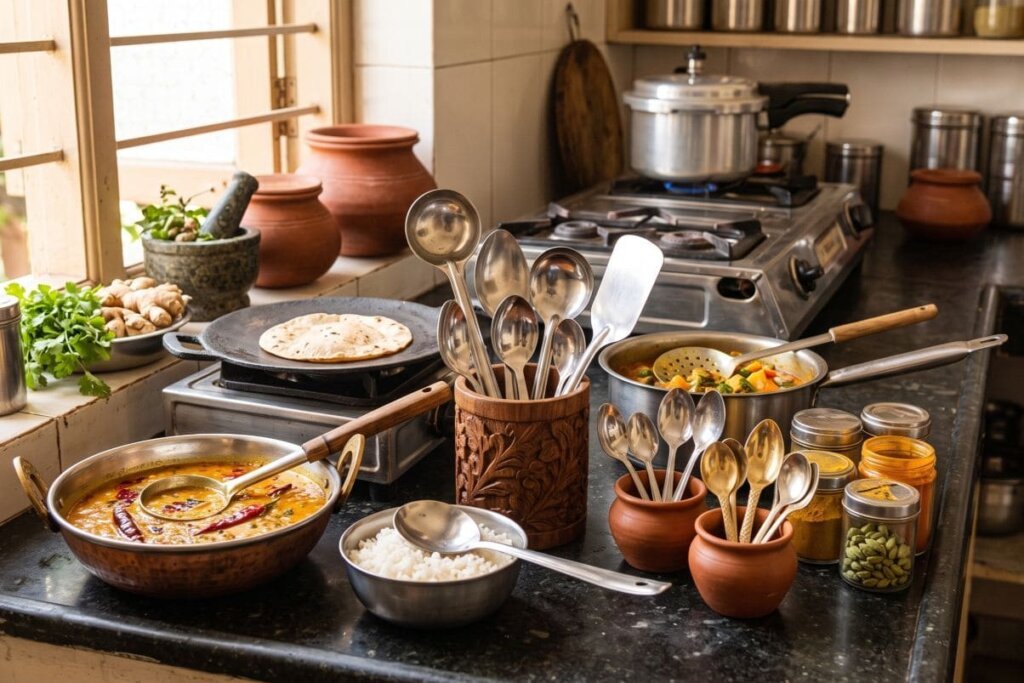
Open a drawer in most Indian kitchens and the same question comes up: which spoon actually belongs where. A degchi of dal needs a different tool from a tawa full of parathas, and the spoon that goes into a wedding thali is not the one used to fry pakodas. Over generations, Indian cooking has settled into a fairly precise set of spoon shapes, each suited to a specific stage of a meal, from the first tempering in the kadai to the last bite of kheer.
Cooking spoons, serving spoons and dining spoons look similar at a glance but are built around different jobs. A cooking spoon has to survive direct heat, stir thick gravies without bending, and sometimes double as a turner. A serving spoon has to move rice, dal or sabzi from a pateela to a plate without spilling, which changes its bowl depth and handle length. A dining spoon has to sit comfortably in the hand for the length of a meal, which is why its size and weight are tuned differently again.
This article walks through the spoon types found across cooking, serving and dining in Indian homes, dhabas, canteens and catering setups, and explains what shapes and finishes each role calls for, from everyday stainless steel spoons and cutlery to the specialised ladles and skimmers used at the stove.
Cooking Spoons Used in Indian Kitchens
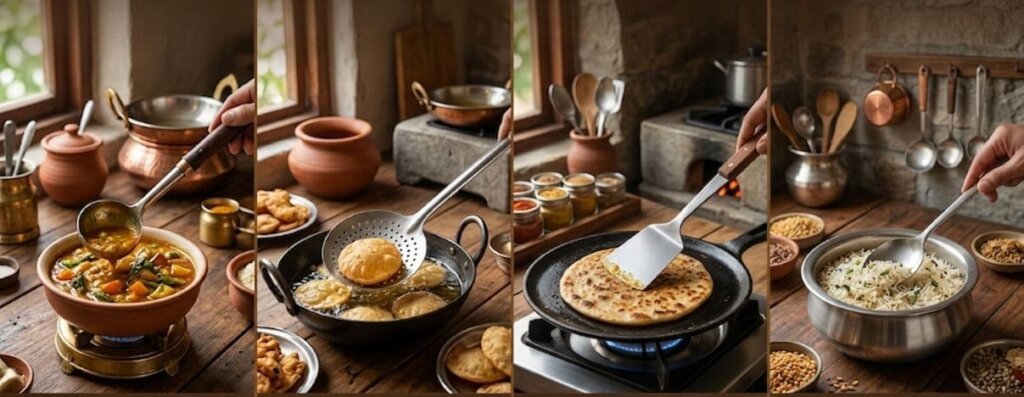
Cooking spoons in an Indian kitchen are working tools first and utensils second. They are chosen for how they perform at the stove, whether that means scraping the base of a kadai, lifting boondi out of hot oil, or folding a tadka into simmering dal without splashing. Most Indian cooks keep four or five of these within arm’s reach of the stove rather than in a drawer, because they are used multiple times in a single meal preparation.
The handles on cooking spoons tend to be longer than those on serving or dining spoons, both to keep the cook’s hand away from heat and steam and to reach the base of a deep pateela or degchi. The bowl or head shape, on the other hand, is where the real variation lies, since each cooking task needs a different geometry.
The Karchi or Ladle
The karchi, also written as karchhi or kalchi in different regions, is the deep ladle used for dal, rasam, sambar, kadhi and other liquid or semi-liquid preparations. Its bowl is rounded and deep enough to hold a full serving in one scoop, and the handle is long enough to stir a large pot of dal without the cook leaning over the steam. Larger karchis are also used to serve rice and pulao at the table, which is why the same word sometimes covers both a cooking tool and a serving one in everyday use.
A well-made karchi in stainless steel holds its shape after years of contact with a hot kadai or degchi, which is where thickness and gauge matter more than in almost any other spoon type. A thin, light-gauge karchi tends to flex or dent when used to scrape the base of a heavy pot, while a heavier gauge keeps its curve and stays balanced in the hand.
The Jhara or Skimmer
The jhara, also called jhaara or zara, is the perforated or wire-mesh skimmer used for deep frying. It is essential for boondi, pakoda, puri and other fried snacks, since it lets the cook lift food out of hot oil while draining the oil back into the kadai. Some jharas have a flat wire-mesh disc on a long handle, while others use a perforated stainless steel bowl, and the choice usually comes down to what is being fried, with mesh preferred for small items like boondi and a perforated bowl preferred for larger pieces like pakoda or vada.
Because the jhara spends long stretches submerged in hot oil, the metal needs to resist discolouration and pitting from repeated heat cycles. Stainless steel is preferred over aluminium or plain steel for this reason, since it does not react with hot oil the way some other metals do, and it cleans up without retaining odour between uses.
The Palta or Khunti
The palta, also known as khunti in parts of North India, is a flat spatula with a triangular, square or rounded head used for turning rotis and parathas on a tawa, flipping items on a flat pan, and stir-frying vegetables in a kadai. It is technically closer to a turner than a spoon, but it is grouped with cooking spoons in most Indian kitchen sets because it performs the same category of stovetop task.
The head of a palta is thin enough to slide under a paratha without tearing it, yet stiff enough not to bend under the weight of a heavier item like a cutlet or a piece of fish. Stainless steel paltas are common because the material does not warp under repeated contact with a hot tawa, unlike some plastic or nylon alternatives that soften at high temperatures.
The Chamcha or Solid Spoon
The chamcha is the general-purpose solid cooking spoon, used for stirring gravies, pouring sauces, tempering spices and mixing dry sabzis. Unlike the karchi, its bowl is shallower and flatter, which makes it better suited to scraping along the flat base of a kadai or pan rather than scooping liquid. Many Indian cooks keep at least two chamchas of different sizes, a larger one for bulk cooking and a smaller one for tempering and quick stirring.
The chamcha is often the first spoon reached for during cooking because of how versatile its shape is. A stainless steel chamcha with a slightly angled neck lets the cook reach into the corners of a kadai, while a straight handle chamcha works better for tall, narrow pateelas.
Serving Spoons for Indian Meals
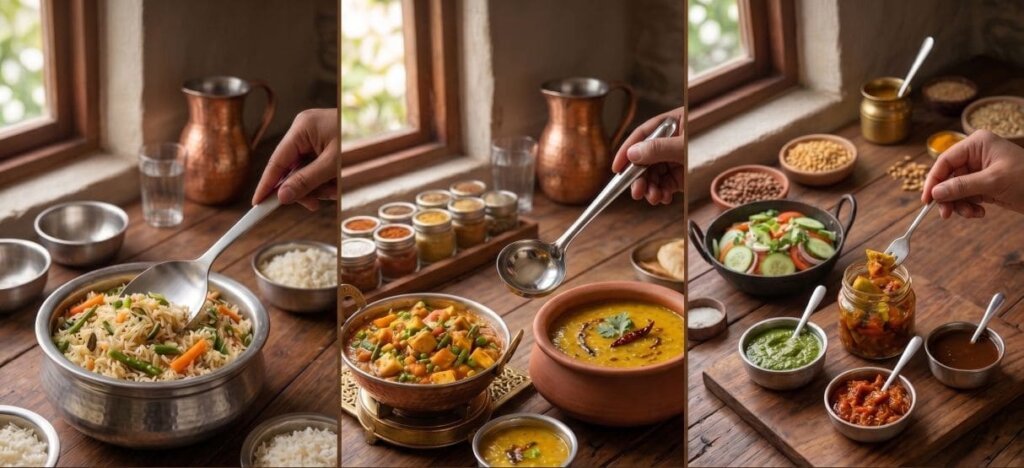
Serving spoons bridge the gap between the stove and the table. Their job is to move food from a cooking vessel or serving bowl onto a plate or thali without spilling, which means the bowl shape, depth and handle length are tuned to the dish being served rather than to any cooking function. A household that eats a typical Indian meal of rice, dal, one or two sabzis and a side of pickle or chutney usually needs at least three distinct serving spoon shapes on the table.
Unlike cooking spoons, serving spoons are meant to be seen and handled by guests as well as the person plating the food, so finish matters more here. A mirror-polished stainless steel serving spoon looks appropriate on a dining table or in a buffet line, while a matte or brushed finish is more common for everyday home use where scratches and daily wear are less noticeable.
Rice and Pulao Serving Spoons
Rice and pulao call for a wide, deep-bowled serving spoon that can lift a generous portion without the grains spilling over the sides. These spoons are usually broader than a karchi and have a flatter base to the bowl, which helps them slide under a mound of rice in a serving dish rather than cutting through it. They are typically bought as part of a broader set of stainless steel kitchenware, since a household rarely buys a single serving spoon in isolation. For biryani and other layered rice dishes, some households prefer a slightly longer handle so the spoon can reach to the bottom of a deep serving pot without disturbing the layers on top.
Weight matters here too, particularly for households or caterers serving large gatherings. A serving spoon that is too light can feel flimsy when lifting a full portion of biryani rice, while one that is properly weighted in heavier gauge stainless steel gives a more stable, controlled scoop, which reduces spillage during festive meals and family functions.
Dal and Curry Serving Spoons
Dal, sambar, kadhi and gravies of all kinds need a deep, rounded serving spoon closer in shape to a karchi than to a rice spoon. The depth of the bowl is what prevents liquid from sloshing out as the spoon moves from the pateela to the plate, and a slightly narrower bowl gives more control when serving into a katori rather than directly onto a thali.
Households that cook tamarind-based gravies, rasam or other acidic preparations regularly benefit from serving spoons in a corrosion-resistant grade of stainless steel, since acidic foods left in contact with lower-quality metal over time can affect both the utensil’s finish and the taste of the food. This is one reason grade selection matters as much for serving spoons as it does for cookware, a factor covered further below.
Salad, Pickle and Chutney Spoons
Condiments, salads, pickles and chutneys are served in much smaller quantities than rice or dal, so their spoons are correspondingly smaller, often closer in size to a large teaspoon than to a full serving spoon. A shallow, small-bowled spoon works well for achaar and chutney, where precision matters more than volume, while a slightly larger slotted spoon is common for salads where excess dressing or water needs to drain off before the portion reaches the plate.
These smaller serving spoons are frequently sold as part of a set alongside the household’s everyday cutlery and thali. A well-matched set in a consistent finish, sometimes paired with a full set of stainless steel thali and tray sets, gives a coordinated look at festive meals, religious functions and family gatherings, which is one reason Indian households often replace an entire serving set together rather than one spoon at a time.
Dining Spoons on the Indian Table
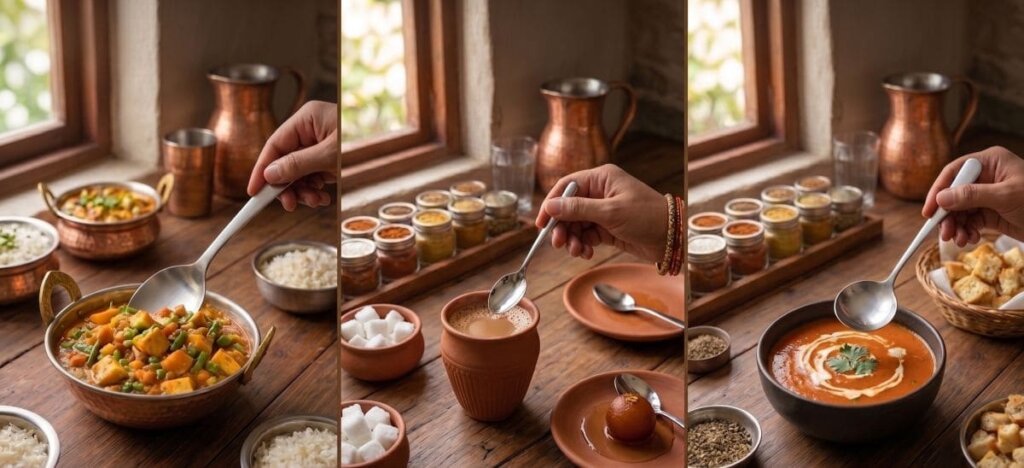
Dining spoons are the ones that actually reach the mouth, and this changes the design priorities again. Comfort, balance and hygiene take precedence over the scooping or stirring performance that matters for cooking and serving spoons. A dining spoon needs to sit well in the hand for the duration of a meal, whether that meal is a quick lunch of dal chawal or a multi-course thali at a wedding.
Indian dining habits also blend traditional and Western table settings more than in many other cuisines, so a typical steel cutlery box in an Indian home usually contains a mix of spoon sizes that would, in a purely Western table setting, be reserved for very specific courses.
The Table Spoon
The table spoon, often just called the dinner spoon, is the largest of the everyday eating spoons and the one most commonly used for a full Indian meal of rice, dal and sabzi. Its bowl is oval and moderately deep, large enough to carry a proper mouthful without being unwieldy, and its handle length is designed for a full grip rather than the more delicate pinch grip used for a teaspoon.
Because the table spoon sees the heaviest daily use of any dining spoon, households tend to buy it in larger sets, often a dozen at a time, and prioritise a mirror or high-polish finish that resists visible scratching from repeated use and dishwashing over months and years.
The Tea or Dessert Spoon
The tea spoon, sometimes called a coffee spoon depending on the region, is a smaller spoon used for stirring tea, coffee and other beverages, as well as for measuring small quantities of sugar or spice. A closely related dessert spoon, slightly larger than a tea spoon but smaller than a table spoon, is used for sweets, kheer, halwa and other desserts common at the end of an Indian meal or during festivals like Diwali.
These smaller spoons are often the first pieces to be gifted or bought individually, since they are inexpensive, come in decorative finishes, and pair well with the small steel or ceramic bowls used for individual dessert portions at family functions and religious ceremonies.
The Soup Spoon
The soup spoon, with its rounded, shallow bowl, is a more recent addition to Indian dining sets, reflecting the growing popularity of soups, both Indian-style shorbas and Chinese-influenced soups, as a starter course in restaurants and at home. Its rounded shape is designed to be sipped from the side rather than tipped into the mouth the way a table spoon is used, which suits thinner liquids better than a deeper, narrower bowl would.
While not every Indian household owns a dedicated soup spoon, hotels, restaurants and catering services that serve a starter course as part of a set menu typically stock them separately from table spoons, since guests notice the difference in a formal dining setting.
Material and Gauge Considerations for Kitchen Spoons
Across all three categories, cooking, serving and dining, the choice of stainless steel grade and gauge affects how a spoon performs and how long it lasts. Grade 202 stainless steel is widely used across Indian kitchenware because it offers a reasonable balance of cost and durability for everyday cooking and serving spoons, while Grade 304 is preferred for products that need higher corrosion resistance, such as spoons that regularly come into contact with acidic gravies, tamarind, pickles or coastal humidity. A closer look at how these two grades compare is available in this comparison of Grade 202 and Grade 304.
Gauge, or the thickness of the steel, matters just as much as grade for spoons that see stovetop use. A karchi or chamcha used directly in a hot kadai needs enough thickness to resist bending under pressure, while a dining spoon can be made in a lighter gauge since it never faces direct heat or the force of scraping a pan. Buyers sometimes look for the 18/8 or 18/10 stamp on steel cutlery as a shorthand for quality, and the meaning behind those numbers, along with what they indicate about chromium and nickel content, is explained in this guide to what 18/8 and 18/10 stamped on steel utensils mean.
Finish is the third variable. A mirror-polished finish is standard for dining and serving spoons that appear on the table, since it looks clean and reflects light well, while a matte or brushed finish is more common for cooking spoons that are handled roughly at the stove and do not need to look decorative. Some manufacturers also offer a satin finish as a middle ground, particularly for hotel and catering cutlery that needs to look presentable while resisting visible scratches from heavy daily use.
Choosing Spoons for Institutional and Commercial Kitchens
Dhabas, hotel kitchens, hospital canteens, wedding caterers and mid-day meal programmes all use spoons differently from a home kitchen, and the purchasing decisions reflect that. Volume is the first consideration, since institutional kitchens buy cooking and serving spoons in bulk and prioritise durability over decorative finish, particularly for karchis, jharas and paltas that are used continuously through a service period rather than occasionally.
Hygiene and ease of cleaning are equally important in these settings. Stainless steel spoons without seams, crevices or plastic components are easier to sanitise between uses, which matters in hospital canteens and mid-day meal kitchens where food safety standards are closely monitored. Weight and balance also become practical concerns when a single cook or server is using the same spoon repeatedly over hours, since a poorly balanced ladle or serving spoon adds unnecessary strain over a full shift.
Bulk buyers, whether they are catering businesses, hotel procurement teams or corporate kitchens, also tend to standardise on a single grade and gauge across their spoon inventory to simplify replacement and maintenance. This is different from a home kitchen, where several different spoon types in varying grades might be bought over years from different sources as needs change.
Conclusion
The range of spoons used in an Indian kitchen reflects how layered Indian cooking and dining actually are, moving from the stovetop tools like the karchi, jhara, palta and chamcha, through the serving spoons that carry rice, dal, curries and condiments to the table, and finally to the dining spoons, table spoons, tea spoons and soup spoons, that guests and family members actually eat with.
Each of these spoon types has settled into its shape for practical reasons built up over generations of cooking and serving Indian food, from the depth needed to scoop dal without spilling to the flat head needed to turn a paratha on a tawa. Understanding these distinctions makes it easier to build a kitchen and dining set that actually matches how a household or commercial kitchen cooks and serves food, rather than relying on a generic assortment of spoons that were not designed with these specific tasks in mind.
Grade, gauge and finish add another layer to this decision, since a spoon that looks identical to another on a shelf can behave very differently once it meets hot oil, acidic gravy or years of daily washing. Paying attention to these factors, alongside the basic shape of the spoon, is what ultimately determines how well a set performs across the cooking, serving and dining stages of an Indian meal.