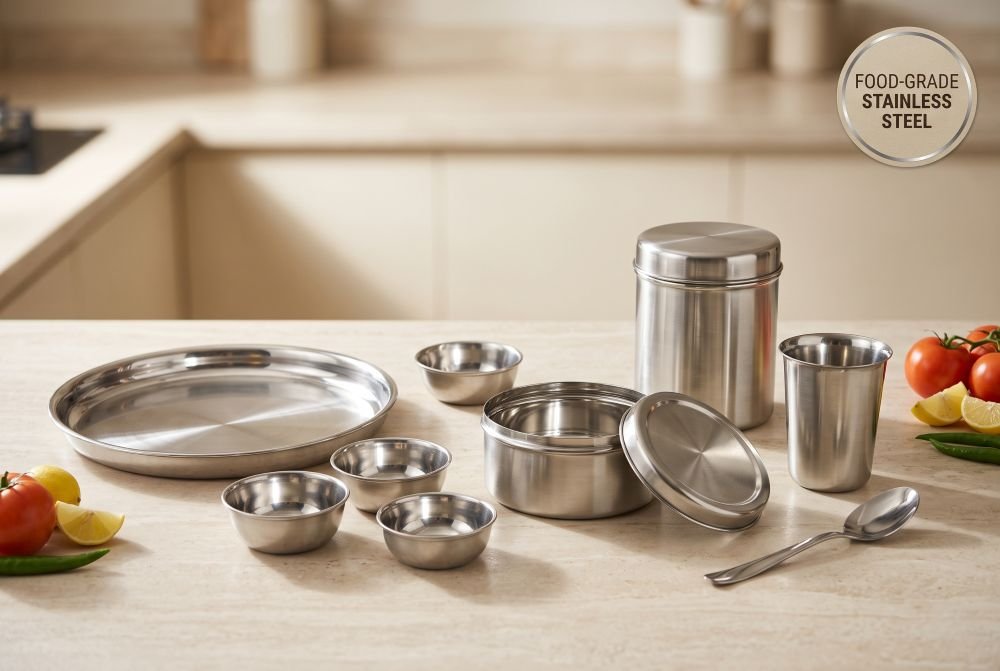
Picture two dabbas on a shop shelf. Both are polished, both are priced within a few hundred rupees of each other, and both carry a sticker that says food grade. A buyer who plans to store pickles in one and carry a tamarind-based sambar in the other has every reason to ask what that sticker actually promises, and whether the two containers are equally safe.
The honest answer is that food grade is a description of purpose, not a single grade of steel. It indicates that a material is intended for contact with food and is expected to remain stable, non-toxic and corrosion resistant under normal use. Which steels meet that description, how Indian standards treat them, and how well they perform with different foods are questions with specific answers.
This guide explains how stainless steel is made safe for food, the grades commonly used for Indian utensils, what BIS and FSSAI require, how acidic and salty foods interact with steel, and how to check a utensil before buying it. Practical references to stainless steel thali sets, storage containers and cutlery appear along the way.
What Food Grade Actually Means
There is no single legal definition of food grade stainless steel that applies to every product. The term is used across the industry to describe steels that are suitable for contact with food, usually because they resist corrosion, do not react readily with common foods and can be cleaned thoroughly. In India, the expectations are set out in food safety regulations and in product standards for utensils, which are discussed later in this article.
The word grade also causes confusion. In metallurgy, a grade such as 304 or 202 refers to a specific chemical composition. Food grade, on the other hand, is a statement about use. A steel can be a recognised grade and still be unsuitable if the finished product is poorly made, has rough welds or is coated with something that should not touch food.
What Makes Steel Stainless and Safe for Food
Stainless steel is an alloy of iron with chromium and other elements, and its useful behaviour depends on how those elements work together. The sections below look at the role of chromium, the effect of nickel, manganese and molybdenum, and the difference between the steel families used in kitchens.
Understanding these basics makes it easier to read a grade stamp or a supplier’s specification and to judge whether a particular utensil suits a particular job.
Chromium and the Passive Layer
Steel is classed as stainless when it contains at least about 10.5 per cent chromium. The chromium reacts with oxygen in the air to form an extremely thin, invisible oxide film on the surface. This passive layer protects the iron underneath from rusting, and it is the reason stainless steel resists staining under ordinary kitchen conditions.
The layer is self-repairing as long as oxygen is available, so light scratches usually heal. It can be damaged, however, by prolonged contact with salt, by harsh scouring and by leaving food residues on the surface for long periods. When the layer is broken faster than it can reform, spots and pits can appear.
Nickel, Manganese and Molybdenum
Nickel stabilises the structure of the austenitic grades and improves their corrosion resistance and formability, which is why grade 304 contains about 8 per cent nickel and is also known as 18/8 steel. Grade 202 replaces part of the nickel with manganese and nitrogen, which lowers the cost and gives good strength, but it also reduces corrosion resistance in demanding conditions.
Grade 316 adds molybdenum to a 304-type composition, and the addition improves resistance to chlorides and acids. That is why 316 is chosen for harsher environments such as coastal installations and for foods with a high salt or acid load, though it costs noticeably more than 304.
Austenitic and Ferritic Families
Grades 304, 316 and 202 belong to the austenitic family, which is generally non-magnetic in its annealed state and is easy to form into the deep shapes that utensils require. Grade 430 belongs to the ferritic family, which contains little or no nickel and is magnetic.
This difference is often used as a quick home test, but it has limits. A magnet will usually identify a ferritic steel, but it cannot reliably tell 304 from 202, since both are largely non-magnetic, and cold working during forming can make austenitic steel slightly magnetic. A magnet is therefore a useful hint and not a proof of grade.
Grades Commonly Used for Utensils in India
Indian utensil makers work with a handful of grades, and each has a recognised place. The right choice depends on the job the utensil must do, the foods it will meet and the budget of the buyer.
The list below summarises the grades most often seen in Indian kitchens, from household thalis to institutional cookware.
- Grade 304 (18/8): Contains roughly 18 per cent chromium and 8 per cent nickel, and is the most widely used food-contact grade worldwide. It offers good corrosion resistance and is a common choice for cookware, storage containers and cutlery.
- Grade 202: A low-nickel austenitic grade with higher manganese content that is widely used in Indian utensils because it forms well and costs less. It is recognised for utensils under Indian standards, though it is less resistant than 304 to prolonged contact with salt and acid.
- Grade 316: A molybdenum-bearing grade used where chloride or acid exposure is high, including some commercial food equipment. It is seldom used for everyday household utensils because of its higher cost.
- Grade 430: A nickel-free ferritic grade used for some cutlery, flatware and the magnetic base plates of induction-compatible cookware. It resists corrosion less well than the austenitic grades.
What Indian Standards and Regulators Say
Two sets of rules shape what counts as safe stainless steel in India. The Bureau of Indian Standards specifies the materials and construction of utensils, and the Food Safety and Standards Authority of India sets requirements for food-contact surfaces in food businesses. Home buyers rely mainly on the first, while restaurants, caterers and canteens must also meet the second.
Neither framework names a single food grade of steel. Together they define acceptable materials, require corrosion resistance and good condition, and leave the buyer to match the grade to the use.
BIS and IS 14756
IS 14756, titled Stainless Steel Utensils, Specification, was revised in 2024 and sets minimum requirements for cooking, serving, table and storage utensils. It requires that the steel used conform to IS 5522, which covers stainless steel sheets and strips for utensils, or to IS 15997, which covers low nickel austenitic stainless steel sheet and strip for utensils and kitchen appliances.
The practical meaning is that Indian standards recognise both standard and low-nickel austenitic steels for utensils, while still setting requirements for composition, thickness, finish and construction. Certified utensils carry the ISI mark and the manufacturer’s licence number, which gives buyers a traceable assurance that is stronger than a printed grade stamp.
FSSAI Requirements for Food-Contact Surfaces
Under Schedule 4 of the Food Safety and Standards (Licensing and Registration of Food Businesses) Regulations, 2011, equipment, utensils and food-contact surfaces used by food businesses must be made of food-grade, non-toxic and corrosion-resistant materials, and they must be kept clean and in good condition.
In June 2026, FSSAI issued an advisory on knives, blades and cutting equipment, directing food businesses to stop using items that are rusted, corroded, chipped, painted or otherwise damaged. Although the advisory concerns cutting tools, it reflects a broader expectation that food-contact steel must be sound, clean and free of surface defects.
How Different Foods Interact With Steel
Indian cooking tests steel more than most cuisines do. Tamarind gravies, tomato-based curries, lemon rice, pickles and brined vegetables all combine acid, salt and heat, and all can stress the passive layer of stainless steel. Over long contact times, a lower grade is more likely to show spotting, dulling or pitting than a higher one.
Laboratory studies on acidic foods cooked for long periods in stainless steel cookware have found small amounts of metals such as chromium and nickel moving into the food, particularly with new cookware and extended simmering. For most people these amounts are small, but anyone who has been advised by a doctor to limit nickel intake should seek medical guidance when choosing cookware. For storage of salty pickles over many months, many households prefer glass or high-grade steel.
How to Check a Utensil Before You Buy
A buyer cannot test steel composition at a shop counter, but a few observations reveal a great deal about quality. The checks below are practical and do not require any equipment.
None of them is conclusive alone, but together they separate well-made items from doubtful ones.
- Look for the ISI mark: A utensil certified under the BIS scheme carries the ISI mark and the manufacturer’s licence number, and the licence can be checked on the BIS website.
- Treat grade stamps as claims: Markings such as SS 304 or 18/8 are helpful, but they are not independently verified, so it is sensible to ask the seller for supporting documents such as a mill test certificate for bulk orders.
- Check weight and thickness: A utensil that feels unusually light or thin for its size may be made from a lower gauge, which dents easily and heats unevenly.
- Inspect finish and construction: Edges should be smooth and rolled, welds should be neat, handles should be firmly fixed, and the interior should be free of pits, burrs and rough patches that can trap food.
- Check lids and seals: A well-fitted lid on a dabba or canister matters for storage, so it should close firmly without wobbling and without damaging the rim.
Choosing the Right Grade for the Job
No single grade suits every use. For daily serving on a thali and tray, a dinner set or a spoon, a well-made utensil in any recognised grade will serve well, provided it is cleaned and dried properly. For storage of acidic or salty foods for long periods, or for kitchens near the coast where humidity and salt in the air are constant, 304 or higher is a safer choice.
Institutional buyers such as schools, hostels and canteens often weigh cost against service life, and they should also consider the regulations that apply to them. Where a utensil will be used heavily for many years, a thicker gauge and a higher grade usually repay their cost. For gifting or light household use, a lower-nickel grade can be a sensible, economical choice when the supplier states the grade clearly.
Care Practices That Keep Steel Food-Safe
Even a good steel utensil can deteriorate if it is neglected. Rinsing off salty or acidic food promptly, washing with a soft sponge, and drying the item before storage all protect the passive layer. Steel wool and harsh abrasives should be avoided, because deep scratches provide places for residues to collect.
Bleach and strong chlorine cleaners can attack the surface and should not be left in contact with steel. Items that develop pits, persistent rust spots or flaking coatings should be retired from food use. Regular inspection is the simplest way to keep utensils safe, and it costs nothing.
Conclusion
Food-grade stainless steel is not a single product but a family of steels that behave well with food when they are correctly specified, well made and properly cared for. Chromium creates the protective layer, nickel, manganese and molybdenum shape how robust that layer is, and the finished utensil determines whether the material delivers its promise.
In India, IS 14756 and the FSSAI food-contact requirements set the framework, and neither limits utensils to a single type of steel. The useful question for a buyer is not whether a utensil is food grade in the abstract, but whether its grade, thickness and construction suit the foods and conditions it will meet.
With a few simple checks, a basic understanding of grades and sensible cleaning habits, steel utensils from dabbas and canisters to spoons and cutlery and everyday kitchenware can serve a household or a business safely for many years. That longevity is, in the end, the most reliable sign that a material has been chosen well.